Why Your Business May Be Invisible Online in 2026 — Even If You Rank on Google
Lekan Ayorinde
May 18, 2026
Reading time: 8 minutes
Your business ranks on Google. Your website is live. You have content published. And yet, decision-makers searching for exactly what you offer are finding your competitors instead — not because your competitors rank higher, but because AI systems are answering questions before users ever reach the search results. This is the quiet disruption happening across digital marketing right now. It has a name — and more importantly, it has a solution.
What Has Actually Changed: From Search Engines to Answer Engines
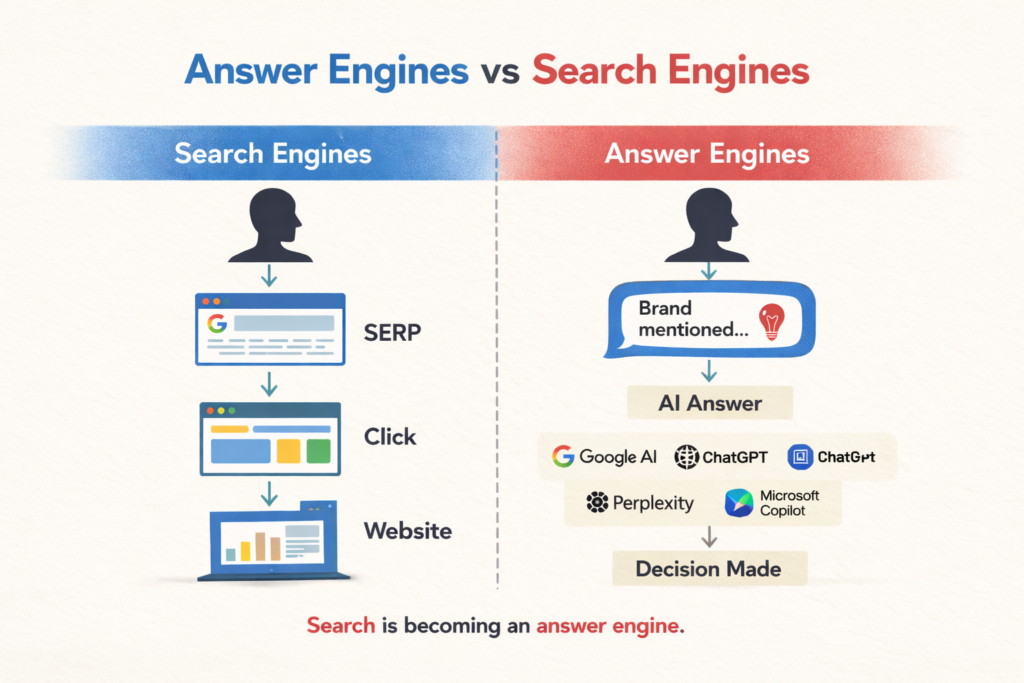
Not long ago, the goal of digital visibility was simple: rank on the first page of Google, get clicked, convert. That model is breaking down. Tools like Google AI Overviews, ChatGPT, Perplexity, and Microsoft Copilot are now answering user questions directly — synthesising information from multiple sources and presenting a single, confident response. The user reads it. Gets their answer. And moves on — without visiting a single website.
Industry research from Semrush confirms that a significant and growing portion of search interactions are now zero-click experiences. Rand Fishkin observed in 2024 that the majority of Google searches now end without a click. Sam Altman has reported hundreds of millions of weekly users on ChatGPT-style systems. Satya Nadella has said plainly: “search is becoming an answer engine.”
This is not a future trend. It is the present reality.
What this means for your business: Ranking on page one of Google is still valuable — but it is no longer sufficient. If your content is not structured in a way that AI systems can read, extract, and trust, you are invisible to a growing percentage of your market.
Two Terms You Need to Understand: AEO and GEO
1. Answer Engine Optimisation (AEO)
AEO is the practice of structuring your content so that AI systems can extract it and present it as a direct answer to a user’s question. Traditional SEO asks: “What keywords should this page rank for?”
AEO asks: “What question is my customer actually typing — and does my content answer it immediately, clearly, and completely?”
The shift matters because user behaviour has changed. People are no longer typing “data analytics Nigeria” into Google. They are asking questions like: “How can a Nigerian business use data to increase revenue?” or “What does managed IT actually cost for a company our size?”
Prabhakar Raghavan of Google has described this directly: search is moving toward understanding intent in natural language, not just matching keywords. If your content is written in corporate language designed for keyword density, it will not be extracted by AI systems optimised for natural questions.
2. Generative Engine Optimisation (GEO)
GEO goes one step further. It is about making sure your brand is included inside AI-generated answers — not just ranked on a results page. When ChatGPT or Google AI Overviews synthesise an answer, they draw on sources they perceive as credible, consistent, and clearly structured. Semrush research shows that brands with consistent cross-platform presence are significantly more likely to be cited inside AI-generated answers.
As AI pioneer Geoffrey Hinton has noted, neural networks build confidence from repeated patterns. In digital terms: the more consistently your brand appears across platforms — your website, LinkedIn, industry publications, directories — the more AI systems trust you as a reference source.
What this means for your business: You are no longer just competing for Google rankings. You are competing to be the brand that AI systems trust enough to quote, summarise, and recommend to your potential customers.
How AI Systems Actually Decide What to Show
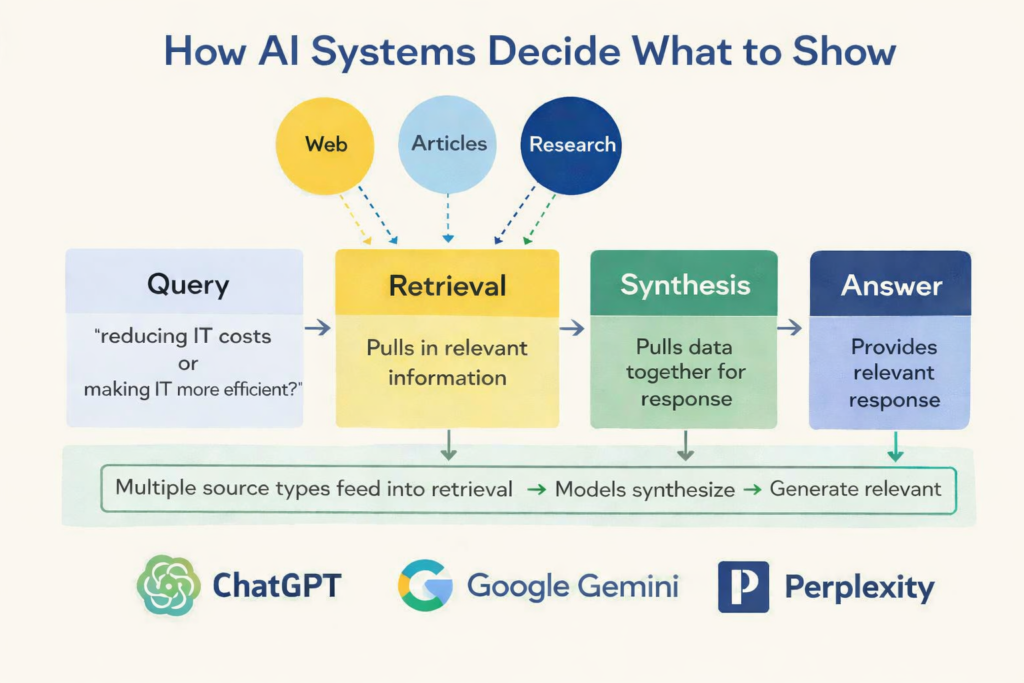
Understanding this is not technical complexity for its own sake — it directly shapes what your content strategy must look like. AI systems like those powering ChatGPT, Google Gemini, and Perplexity use three key mechanisms:
1. Natural Language Understanding (NLU)
The AI interprets user intent — not just the keywords in a query, but the meaning behind them. It is also know as Query Understanding. A question about “reducing IT costs” and “making IT more efficient” may be asking the same thing. AI knows this. Your content should reflect it.
2. Retrieval-Augmented Generation (RAG)
The AI pulls real-time or indexed information from external sources to support its answers. Content that is self-contained, factual, and clearly structured is far more likely to be retrieved and used. These content can com
3. Entity Recognition
AI systems build an understanding of what a brand represents across the web. If your brand name appears consistently across your website, LinkedIn, Google Business profile, and industry mentions — all describing the same services in similar language — AI systems begin to recognise and trust your brand as a credible entity.
The practical implication: content that is clear, structured, and consistent across platforms performs best inside AI-generated answers.
Why This Matters More in Africa Than Anywhere Else
For businesses in Nigeria and across Africa, this shift carries a specific strategic opportunity — not just a warning. Markets like Nigeria are navigating three simultaneous realities:
Rapid growth in internet penetration and mobile-first search
Increasing competition from global brands entering local markets digitally
A gap in brand authority signals compared to legacy global competitors
Here is what AI-driven search does to that equation: it compresses the gap.
AI systems prioritise clarity of information, structured explanations, and consistent cross-platform credibility — not legacy authority or domain age. As entrepreneur Iyinoluwa Aboyeji has noted, Africa’s digital growth allows businesses to leapfrog traditional systems.
A Nigerian technology company with exceptionally structured, authoritative content can appear in AI-generated answers alongside — or instead of — global competitors, simply because its content is better prepared for how AI systems work.
Gartner research projects that by 2026, a significant portion of organic discovery will shift toward AI-mediated interfaces. The businesses that adapt now will compound that early advantage. Those that wait will face a visibility gap that becomes harder to close over time.
What this means for your business: The playing field is shifting in your favour — but only if you act. AEO and GEO are not tools for established global brands. They are opportunities for ambitious regional businesses to claim authority before the window closes.
The New Measurement Problem: Visibility Without Traffic
Here is the paradox that is catching many businesses off-guard. AI systems often answer user questions using your content as a source — without sending users to your website. Your brand may be influencing decisions without your analytics capturing any of it. As McKinsey research consistently shows, over 70% of B2B buyers conduct extensive digital research before engaging a sales team. If your brand appears in AI-generated answers during that research phase, you are shaping the buyer’s thinking — even if they never click through to your site.
This changes what success looks like in digital marketing:
It is no longer just about clicks and impressions
It is about brand mentions inside AI answers
It is about how your brand is described when an AI summarises your industry
It is about what context surrounds your name when a decision-maker asks an AI who to trust
Traditional analytics will not capture this. Businesses need to start auditing how they appear inside AI systems — not just how they rank on Google.
The 5-Point AEO & GEO Readiness Checklist
Use this to assess where your business stands today.
1. Are your service pages written as answers to questions?
Not descriptions of what you do — but direct answers to what your customers are asking. Example: instead of “We offer managed IT services,” write “Here is what managed IT services include, what they cost, and when a growing company should consider outsourcing IT.”
2. Does your content use natural, conversational language?
AI systems process meaning, not just keywords. Write the way a smart, informed advisor speaks — not the way a brochure is formatted.
3. Is your brand consistently described across platforms?
Your website, LinkedIn page, Google Business profile, and any industry directories should describe your services in consistent language. Inconsistency confuses AI entity recognition systems.
4. Do you have structured, self-contained content pieces?
FAQs, how-to guides, explainers, and frameworks perform exceptionally well in AI retrieval. Each piece should be able to stand alone as a complete answer to a specific question.
5. Are you publishing regularly and cross-referencing your own content?
Internal links between your blog posts, service pages, and resources help AI systems build a complete picture of what your organisation knows and offers.
What Firstlincoln Does About This
At Firstlincoln, we work with business leaders who are navigating exactly this kind of shift — technology changes that look like marketing problems but are actually strategic infrastructure decisions.
AI-driven search is not just a content challenge. It is a systems challenge: how your digital knowledge is structured, how consistently your brand is represented across platforms, and how clearly your expertise is communicated to both human readers and AI systems.
Our technology consulting and digital strategy work helps organisations build the foundations that make this kind of visibility possible — not just for search engines, but for the AI systems that are increasingly mediating how your customers discover, evaluate, and choose their technology partners.
The Bottom Line
Ranking on Google is still important. But in 2026, it is only part of the picture.
The businesses that will maintain and grow their digital visibility are those that understand how AI systems work — and structure their content, their platforms, and their brand presence accordingly.
The question is not whether this shift is happening. It already is.
The question is whether your business is positioned to be found, trusted, and recommended by the AI systems your customers are already using.
To provide the best experiences, we use technologies like cookies to store and/or access device information. Consenting to these technologies will allow us to process data such as browsing behavior or unique IDs on this site. Not consenting or withdrawing consent, may adversely affect certain features and functions.
Functional
Always active
The technical storage or access is strictly necessary for the legitimate purpose of enabling the use of a specific service explicitly requested by the subscriber or user, or for the sole purpose of carrying out the transmission of a communication over an electronic communications network.
Preferences
The technical storage or access is necessary for the legitimate purpose of storing preferences that are not requested by the subscriber or user.
Statistics
The technical storage or access that is used exclusively for statistical purposes.The technical storage or access that is used exclusively for anonymous statistical purposes. Without a subpoena, voluntary compliance on the part of your Internet Service Provider, or additional records from a third party, information stored or retrieved for this purpose alone cannot usually be used to identify you.
Marketing
The technical storage or access is required to create user profiles to send advertising, or to track the user on a website or across several websites for similar marketing purposes.