
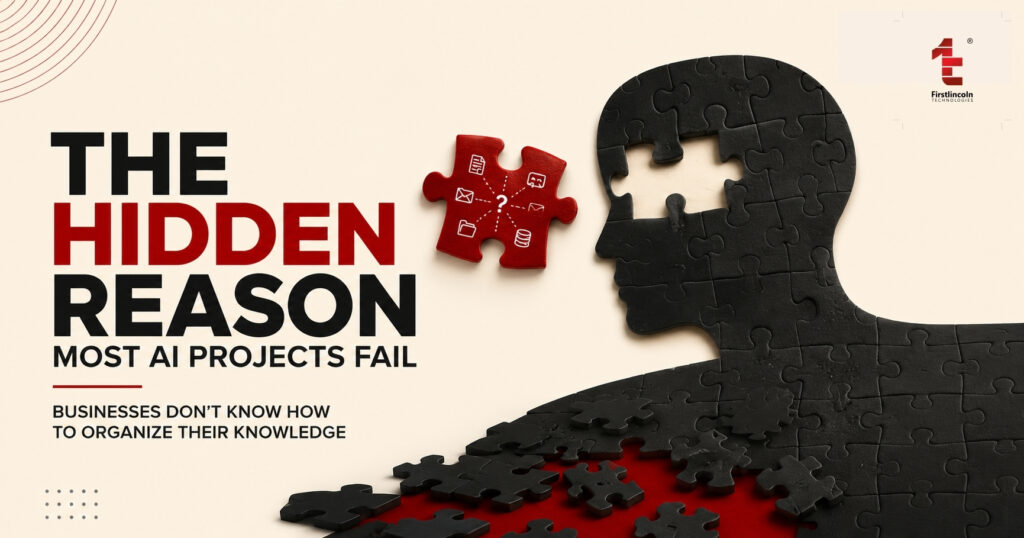
AI adoption challenges are becoming one of the biggest barriers preventing organizations from successfully scaling artificial intelligence. While businesses are investing in copilots, automation platforms, AI assistants, and large language models, many discover that technology alone cannot solve poor information foundations. Organizations are investing in copilots, automation platforms, AI assistants, and large language models with the expectation that these technologies will transform how they operate.
But there is a challenge many leaders discover too late: AI cannot create intelligence from information an organization cannot find, trust, or understand. At FirstLincoln, we believe the biggest barrier to successful AI adoption is not the technology itself. It is the foundation underneath it.
Across industries, businesses are attempting to build intelligent systems on top of fragmented information environments — where critical knowledge is scattered across contracts, emails, PDFs, spreadsheets, collaboration tools, and disconnected business systems.
The result is predictable. AI systems may be powerful, but they lack the context required to provide reliable answers.
This challenge is not unique to individual organizations. Research across the technology industry points to the same conclusion: the success of AI depends heavily on the quality of the data, systems, and knowledge foundations supporting it.
In Gartner’s February 26, 2025 report, Lack of AI-Ready Data Puts AI Projects at Risk, the company emphasized that organizations need AI-ready data foundations to successfully scale AI initiatives, highlighting that AI projects are at risk when they are not supported by reliable and structured data environments.
Similarly, Boston Consulting Group (BCG), in its May 13, 2024 article, Secrets to Scaling GenAI in Information Services, identified challenges including data preparation, data management, systems integration, and organizational capability as major barriers preventing companies from scaling generative AI effectively.
RAND Corporation, in its 2024 research report, The Global Technology Race: AI, Semiconductors, and the Future of Innovation, highlighted that “data-related problems are among the top reasons AI projects fail,” emphasizing the importance of strong data infrastructure and readiness.
MIT Sloan, in its January 28, 2025 article, 6 Ways Businesses Can Leverage Generative AI, also highlighted challenges around data readiness, infrastructure, and integrating AI into existing business systems.
For a deeper dive into why disorganized knowledge is the hidden killer of AI projects, read our related article: Most Companies Have a Data Problem, Not an AI Problem. The conclusion is clear: most organizations do not have an AI problem. They have a knowledge organization problem.
The Enterprise Knowledge Problem Behind AI Adoption Challenges
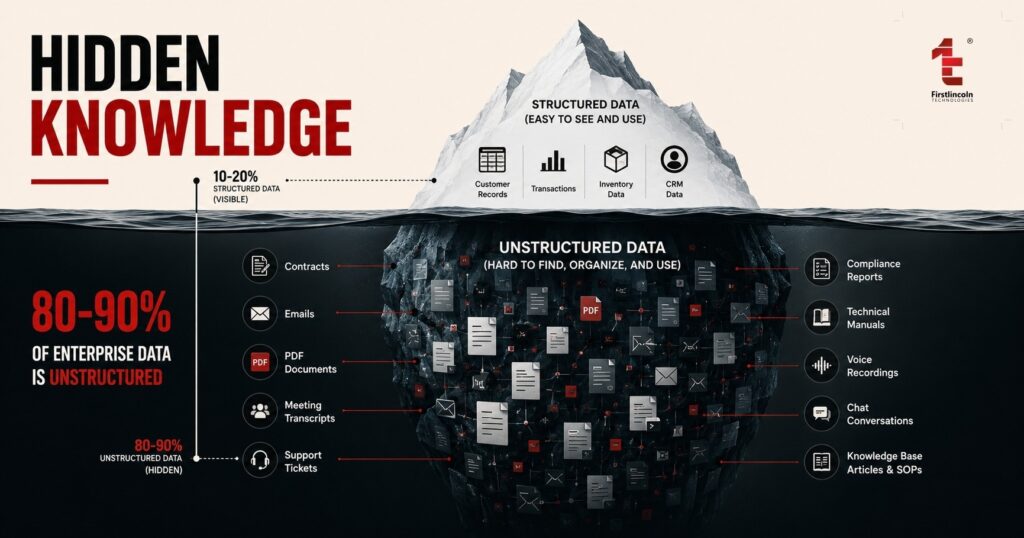
Most of the information that drives business decisions isn’t in a neat database. It’s buried in contracts, emails, PDFs, meeting transcripts, and support tickets—knowledge that machines can’t read without help.
Structured data—like customer records, transactions, or inventory counts—is predictable and easy to store in rows and columns. For example:
| Entity ID | Corporate Counterparty | Primary System Email | Contract Value (USD) |
| GLOBAL-01 | Apex Logistics Worldwide | operations@apexlogistics.com | $500,000 |
| GLOBAL-02 | Vertex Manufacturing Ltd | procurement@vertexmfg.com | $1,250,000 |
These datasets are important, but they represent only a fraction of an organization’s total knowledge. According to research cited by IBM, Dell Technologies, and multiple industry studies, as much as 80% to 90% of enterprise data is unstructured.
Unstructured data includes:
- Contracts
- Emails
- PDF documents
- Meeting transcripts
- Customer support tickets
- Technical manuals
- Compliance reports
- Voice recordings
- Chat conversations
- Knowledge base articles
- Standard operating procedures
This is where the majority of institutional knowledge lives. It contains customer commitments, operational processes, compliance obligations, commercial agreements, project histories, and critical business decisions. Unfortunately, it is also the information that organizations struggle to organize.
Why Unstructured Data Creates AI Failure
Large Language Models can appear remarkably intelligent. However, intelligence without context is unreliable. As Andrew Ng has repeatedly emphasized, AI systems are fundamentally dependent on the quality and availability of the data used to support them.
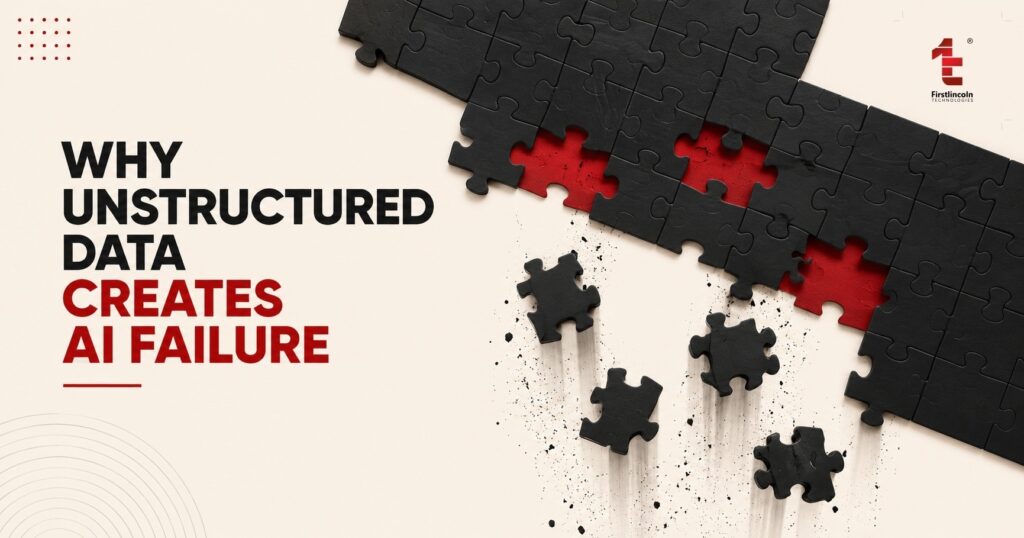
When enterprise information is fragmented across dozens of disconnected systems, AI tools lose the context required to generate trustworthy responses. Imagine asking an AI assistant: Which supplier contracts expose us to penalties if delivery deadlines are missed?
The answer may exist.
But the relevant information could be spread across:
- A contract stored in SharePoint
- An amendment saved in a PDF
- An email clarification from legal counsel
- A customer complaint ticket
- A procurement team’s internal chat discussion
Without a mechanism for finding, validating, and connecting those sources, the AI system is forced to make assumptions. This is one of the primary causes of hallucinations in enterprise environments. The problem isn’t that the model is unintelligent. The problem is that the organization’s knowledge is disorganized.
Why Databases Are Easy and Business Knowledge Is Hard
Structured data naturally fits into predefined formats. A customer record can be stored as:
| Customer ID | Company | Annual Revenue | |
| 001 | Apex Logistics | info@apex.com | $500,000 |
Computers excel at processing this type of information. Unstructured information is fundamentally different. Consider a supplier agreement.
A single PDF may contain:
- Contract value
- Renewal dates
- Termination clauses
- Regulatory obligations
- Geographic restrictions
- Service-level commitments
- Liability provisions
Humans can read and understand these details immediately. Machines cannot. Before AI can reason over this information, it must first be transformed into something machines can understand. This transformation process is where most organizations struggle.
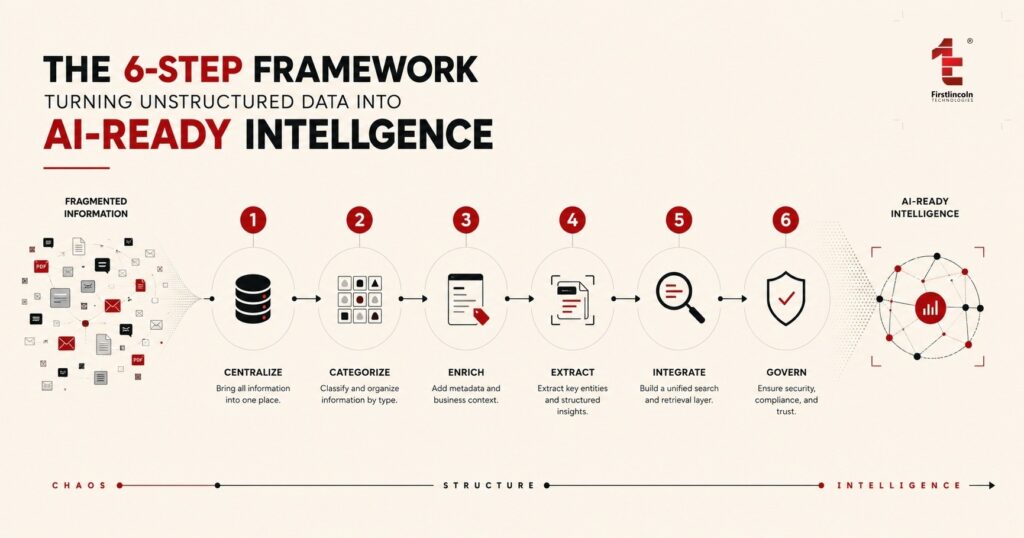
The Six-Step Framework for Turning Unstructured Data Into AI-Ready Intelligence
Leading organizations do not simply feed documents into an AI model and hope for the best. Instead, they follow a structured information management process.
1. Centralization: Centralize Information
An AI engine cannot utilize context it cannot access. The first challenge is fragmentation. The first phase of data readiness is eliminating the practice of allowing vital business data to live across 20 disconnected ecosystems. A global enterprise may have information stored in:
- Microsoft 365
- Google Workspace
- SharePoint
- Dropbox
- Salesforce
- Zendesk
- Slack
- Microsoft Teams
- Local file servers
According to research from World Economic Forum, data fragmentation remains one of the biggest barriers to digital transformation and enterprise intelligence initiatives. The objective is not necessarily to move every file into one location. The objective is to create a unified access layer that allows information to be discovered, indexed, and governed consistently.
collected, indexed, and accessed consistently. This may be a cloud data lake, document management platform, enterprise knowledge base, or a combination of all three. Without centralization, intelligence remains trapped in silos.
2. Categorization: Categorize and Classify Content, Automated Content Classification
Once information becomes accessible, it needs structure. Classification systems help organizations understand what type of information they possess.
For example:
| Document | Category |
| Employment Contract | HR |
| Vendor Agreement | Procurement |
| Customer Complaint | Customer Experience |
| Financial Statement | Finance |
Classification dramatically improves discoverability. More importantly, it creates the foundation for governance, compliance, and AI retrieval. Note: Without classification, search becomes impossible. And without search, AI becomes blind.
3. Enrichment: Enrich Information With Metadata
Metadata is often described as “Data that describes other data”. While that sounds technical, the concept is simple. Think of metadata as the label attached to a file. Without the label, the document is just another PDF sitting in a folder. With the label, it becomes a searchable business asset.
Metadata provides explicit context, structural tags, and search boundaries that an AI algorithm requires to locate and understand files without reading millions of characters line-by-line.
For a contract, metadata might include:
- Created date: January 2026
- Business unit: Legal
- Contract value: $5M
- Counterparty: XYZ Holdings Ltd. (the other party to the contract)
- Expiration date: December 2028
- Jurisdiction: United Kingdom (the governing legal system or court authority)
- Risk level: High (based on financial exposure, compliance obligations, or strategic importance)
- Owner/Client: ABC Limited
Research from AIIM consistently highlights metadata as one of the most important components of modern information governance programs.
Without metadata, documents are invisible. With metadata, they become searchable business assets. With a structured metadata architecture, users and automated agents do not need to search through hundreds of nested subfolders.
They can search the system programmatically: “Retrieve all commercial agreements valued above $1 million expiring within the next 180 days.”
4. Extraction: Extract Business Intelligence From Documents
At this stage, organizations begin using AI and automation tools to extract structured insights from documents. Advanced data engineering systems use specialized language models to extract specific semantic entities from raw paragraphs and convert them into tidy database tables. Modern document intelligence systems can identify key entities inside unstructured content.
For example: A contract sentence may state: This regional distribution agreement shall officially terminate on December 31, 2028 and carries a total value of $5 million.
An extraction engine can automatically identify:
- Expiration Date: December 31, 2028
- Contract Value: $5 million.
The information is then converted into structured records that can be analyzed, monitored, and queried.
According to McKinsey & Company, document processing and knowledge extraction represent some of the highest-value use cases for enterprise AI because they unlock information that was previously inaccessible.
5. Integration: Build an Enterprise Search and Retrieval Layer
This is the stage where Retrieval-Augmented Generation (RAG) becomes powerful. One of the biggest limitations of large language models is that they cannot automatically access a company’s internal knowledge.
This challenge gave rise to Retrieval-Augmented Generation (RAG), a framework that allows AI systems to retrieve relevant company documents before generating answers. Instead of manually searching folders, employees can ask natural-language questions.
For example:
Which supplier agreements expire within six months?
Or:
Summarize recurring customer complaints across our European operations during the last quarter.
The system retrieves relevant source documents, validates context, and generates an answer grounded in actual enterprise knowledge. This significantly reduces hallucinations while increasing trust in AI outputs.
6. Governance: Establish Governance and Trust
This is the critical phase most organizations skip, causing their technical infrastructure to break down over time into operational chaos. Technology alone is not enough.
The most mature organizations recognize that information governance is essential for sustainable AI adoption. True system readiness requires definitive answers to foundational governance rules:
- Data Provenance: Which version of this document is the absolute, legally binding single source of truth? What compliance obligations apply?
- Access Control Layering: Who can access sensitive information? Can an automated customer service chatbot access sensitive executive HR records or internal financial payroll folders?
- Lifecycle Auditing: How long must transaction data be kept before it is automatically archived to remain compliant with international frameworks? How should AI-generated outputs be audited?
Both World Economic Forum, OECD and NIST emphasize governance, transparency, and accountability as foundational requirements for trustworthy AI. Without governance, AI can create new risks even while solving old problems.
The Framework in Action: Cross-Border Logistics Strategy
Consider the real-world operational reality of a multi-market enterprise handling international supply chains and cross-border trade corridors.
Every single day, their business data is scattered across thousands of disconnected touchpoints. Like:
- Customs documentation
- Freight invoices
- Driver reports
- Customer complaints
- Route optimization reports
- multi-currency invoices
- Email communications
- Messaging platform conversations
Without structure data pipeline, finding answers can take days. Managers search through inboxes. Operations teams review spreadsheets. Compliance officers dig through archived PDFs.
The process is slow, expensive, and error-prone. By executing a proper data engineering sequence, the transformation is absolute:
- Centralize: All files, emails, and agent chat logs ingest automatically into a secure cloud environment.
- Classify: Documents are instantly tagged by country, hub, and department.
- Enrich & Extract: Key information—dates, route delays, financial costs—is pulled out into a structured database.
- Govern: Access permissions ensure sensitive client data is viewable only by authorized personnel.
After implementing a structured knowledge framework, the same organization can ask:
“Show all client complaints regarding clearing delays above 24 hours at our major ports during the last quarter, and cross-reference them with our financial liability exposure.”
Instead of launching a three-day investigation, the answer appears in seconds. That is not simply automation. It is organizational intelligence.
The Future of AI Belongs to Organizations That Organize Knowledge
The winners of the AI era will not be the organizations that buy the most models. They will be the organizations that know where their knowledge lives, can trust the information they hold, and can make it available to both humans and machines.
As Thomas Davenport has argued for years, successful AI initiatives depend as much on information management and organizational readiness as they do on algorithms.
The companies generating real AI returns are not necessarily using better models. They are providing better information. Before investing in another chatbot, another copilot, or another AI platform, leaders should ask a simpler question:
Can our organization actually find, trust, and use its own knowledge?
Because AI cannot create intelligence from information it cannot understand. And in most organizations, the real transformation begins long before the first AI model is deployed.
Let’s build the structured, trusted, and accessible data architecture your enterprise needs to scale AI successfully.
- Connect with our Team: info@firstlincoln.net
- Initiate an Infrastructure Consultation: firstlincoln.net/contact-us