
Across industries, a consistent pattern is emerging in how artificial intelligence succeeds or fails inside enterprises: the limiting factor is rarely the AI itself, it is the condition of the organization it is deployed into.
The core issue is not access to AI systems, but the attempt to apply intelligence on top of fragmented, inconsistent, and poorly governed data environments, scaling intelligence before the foundation it depends on is structured.
Organizations are generating more data than ever, yet much of it remains scattered across disconnected systems, duplicated across departments, or locked in unstructured formats. As a result, even advanced AI systems operate with incomplete context and inconsistent signals.
This pattern is consistently reflected across industry research and leadership perspectives. Microsoft CEO Satya Nadella has emphasized that AI value is tied to data quality and workflows. Thomas Davenport of Babson College and MIT’s Initiative on the Digital Economy argues that competitive advantage depends on structured enterprise information. Research from Stanford and Carnegie Mellon reinforces the same conclusion: technical capability alone is insufficient without organizational readiness.
Across these signals, a clear message emerges: AI does not create value in isolation, it amplifies the system it is placed inside.
The real gap is not AI capability but organizational readiness. Companies are investing heavily in intelligence systems while their data environments remain fragmented.
The paradox is simple: intelligence is being built on top of disorganization.
This is where most organizations misread the problem.
Executives often attribute AI failures to the wrong factors: blaming the model, the vendor, or the quality of implementation. However, research suggests that many failures are caused by deeper structural issues, including weak data foundations, disconnected systems, and poor governance.
This challenge is reflected in RAND Corporation’s 2024 research report The Global Technology Race: AI, Semiconductors, and the Future of Innovation, which states that “data-related problems are among the top reasons AI projects fail,” highlighting the importance of stronger data infrastructure for successful AI adoption.
Gartner reached a similar conclusion in its January 15, 2025 report Quick Answer: What Are the Major Data Risks for AI?, stating that “a very frequent driver of failures of AI/GenAI projects is data,” and noting that AI outcomes are highly vulnerable to poor data collection, management, quality, and protection.
These findings show that AI success depends less on simply choosing a powerful AI model and more on whether an organization has the right data, systems, and governance structures in place.
Most organizations do not have an AI problem.
They have a structural one.
Their data is fragmented, their systems are disconnected, and their knowledge is not organized to support intelligence. When AI enters this environment, it does not fix the disorder, it exposes it.
Artificial intelligence is not the starting point of transformation.
It is the outcome of it.
And when the foundation is weak, intelligence does not correct the weakness, it accelerates it.
Why AI Exposes Problems Instead of Solving Them
Many executives approach AI as if it were another piece of enterprise software something that can simply be purchased, deployed, and expected to produce immediate results. But AI behaves very differently.
Imagine hiring the world’s smartest librarian. If every book in the library is mislabeled, duplicated, outdated, or scattered across five different buildings, the librarian does not become less intelligent. He simply spends his day retrieving bad information faster.
AI behaves the same way.
When organizations feed conflicting customer records, disconnected spreadsheets, and fragmented knowledge into intelligent systems, those systems do exactly what they were designed to do: they learn from everything including the errors.
That is why the World Bank argues that sustainable AI adoption depends on what they call the “4Cs”—Connectivity, Compute, Competency, and most importantly, Context (Data)—the quality and structure of the underlying data.
Once organizations understand that AI magnifies the quality of the systems beneath it, a more important question emerges: what exactly causes those foundations to break down?
This same principle applies beyond internal systems. Even if your company ranks on Google, AI-driven answer engines may still make you invisible to customers. Learn more in our related article: Why Your Business May Be Invisible Online in 2026.
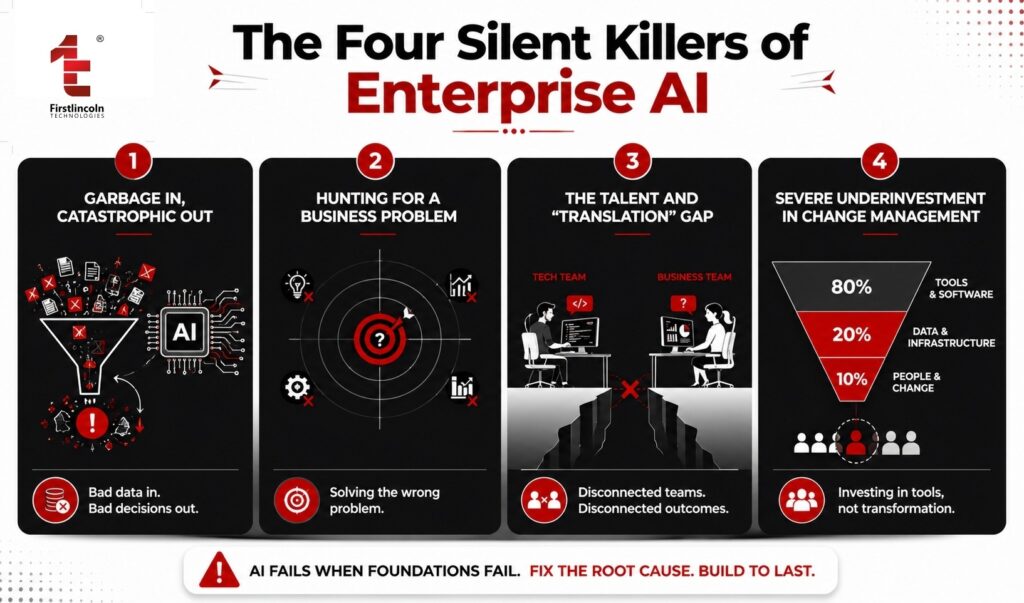
The Four Silent Killers of Enterprise AI
According to data from Gartner, poor data quality remains the primary technical driver of enterprise AI failure. However, a deeper cross-industry analysis by the RAND Corporation and MIT Sloan Management Review reveals that advanced technology models are ultimately rejected by corporate ecosystems due to a combination of four distinct structural blind spots:
1. “Garbage In, Catastrophic Out” (How Broken Data Inherits Speed)
AI has no human intuition. It processes data exactly as it receives it. If the foundation is flawed, organizations don’t automate efficiency they automate mistakes. The principle of “Garbage In, Garbage Out” has not disappeared in the age of AI. It simply operates faster and at much greater scale.
2. Hunting for a Business Problem
Many AI initiatives begin with the technology rather than the commercial reality. Teams build or buy brilliant, expensive systems to solve problems that the business side doesn’t actually care about or need. The outcome is technical success, but total commercial failure.
3. The Talent and “Translation” Gap
Enterprises often lack an internal translation layer professionals who understand both corporate strategy and data engineering. Without this cross-functional alignment, technical developers build models in an isolated silo, completely disconnected from the daily workflows of the operational teams who are supposed to use them.
4. Severe Underinvestment in Change Management
Sustainable technology transformation follows a strict global blueprint known as the 10-20-70 Rule (popularized by research from firms like BCG): 10% of the effort and capital goes into the actual Algorithms and Models, 20% goes into the underlying Data Infrastructure and Cloud Pipelines, 70% must be dedicated to Business Processes, Change Management, and Up-skilling People.
Failing organizations invert this completely spending 80% into models, while spending close to zero on their data plumbing, preparing their workforce to handle the operational change.
Why Information Naturally Fragments
Most companies do not suffer from an absence of data; they suffer from a lack of structure. As an enterprise grows, its information naturally becomes scattered across different functional silos:
- Sales teams use one software tool.
- Finance teams track invoices on another isolated platform.
- Operations teams rely on “temporary” Excel sheets that somehow become permanent corporate fixtures.
As Dr. Olubayo Adekanmbi, founder of Data Science Nigeria (DSN), frequently emphasizes: Africa’s systemic competitive advantage in the digital age will not come from buying foreign software licenses, but from building clean, highly localized, and structured datasets.
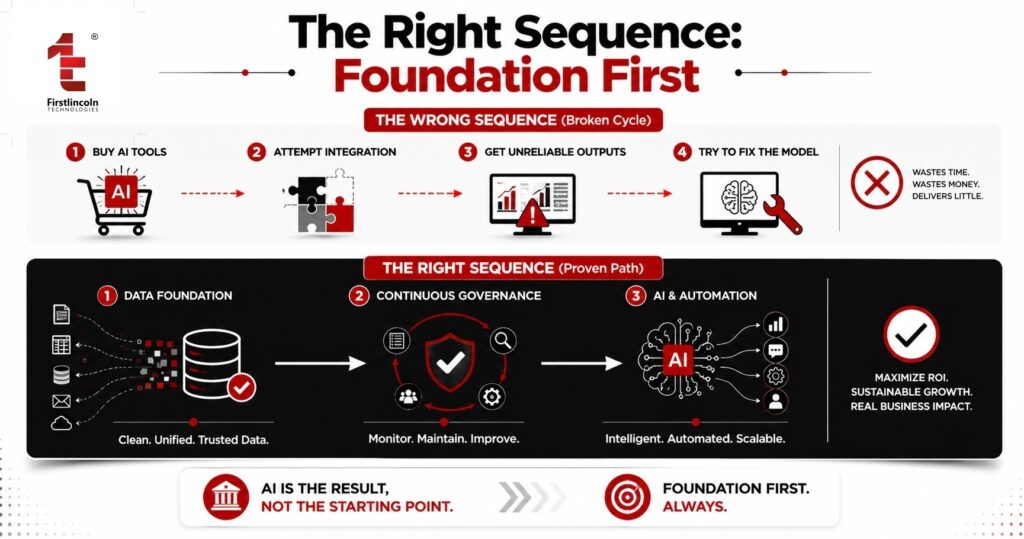
The Right Sequence: Foundation First
The single biggest mistake organizations make with digital transformation is incorrect sequencing. They buy the flashy solution before they fix the underlying plumbing. From fast-scaling mid-market firms to complex multinational enterprises, businesses continually fall into a predictable, broken cycle:
[ Buy AI Tools ] ──> [ Attempt Integration ] ──> [ Get Unreliable Outputs ] ──> [ Try to Fix the Model ]
This approach is entirely backward. AI is not the starting point of your digital transformation journey; it is the ultimate result of it.
To achieve a meaningful return on investment (ROI), successful global enterprises follow a strict, logical sequence:
[ 1. Data Foundation ] ───> [ 2. Continuous Governance ] ───> [ 3. AI & Automation ]
- Build a Clean, Unified Data Foundation: Gather your fragmented data into one structured place.
- Establish Continuous Data Governance: Implement automated systems to keep that data clean in real time.
- Deploy AI Systems on Top: Let the technology do the job it was actually designed to do.
Without step one, your entire corporate AI strategy collapses.
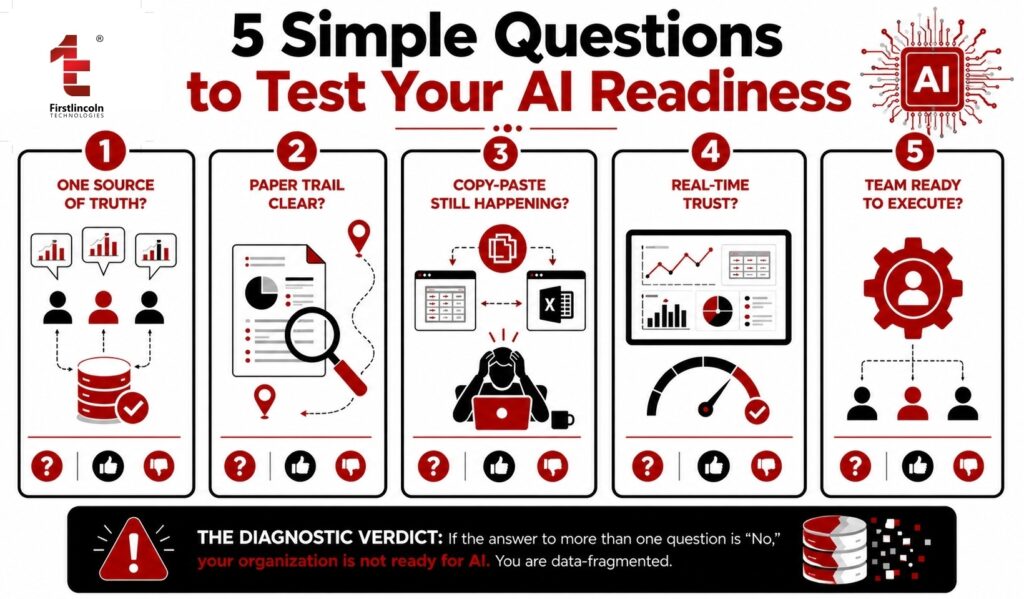
5 Simple Questions to Test Your AI Readiness
You don’t need an exhaustive, months-long consulting project to figure out if your organization is ready to build with artificial intelligence.
In their global tech readiness blueprints, the IBM Institute for Business Value emphasizes that true AI maturity is not determined by data volume, but by its daily operational friction. If your staff is constantly fighting with basic data retrieval, an automation model will only choke on that friction.
Before you buy your next piece of software, run your leadership team through these five everyday operational questions:
- The “One Source of Truth” Test: Do your sales, finance, and operations teams actually agree on basic numbers? Or are you spending the first 20 minutes of every executive meeting arguing over whose spreadsheet has the “correct” revenue and customer count?
- The Paper Trail Test: If a critical financial or customer metric looks completely wrong on a report, can your managers immediately trace it back to where it entered your company? Or does fixing it require an emergency, multi-day game of office detective work?
- The Copy-Paste Test: Can your different software tools seamlessly share information on their own? Or are you paying highly qualified employees to spend their afternoons manually exporting CSV logs, copy-pasting entries, and fixing broken Excel files?
- The Real-Time Trust Test: Can you look at your operational dashboard right now and confidently make an expensive business decision? Or do you have to wait for “end-of-month reconciliations” and manual data cleanups before you trust the numbers?
- The Human Execution Test: If your company deploys a powerful automation tool tomorrow, does your operational team actually know how to feed it, manage it, and fix it? Or will it sit idle because it lacks human capability support?
The Diagnostic Verdict: If the answer to more than one of these questions is “No,” your organization is not ready for AI. You are data-fragmented.
The Firstlincoln Perspective: Systems + People
After 25 years and more than 1,500 engineering projects, we have learned a simple lesson: technology rarely fails because organizations lack intelligence. It fails because the systems beneath that intelligence were never prepared to support it.
Before investing in another AI platform, organizations should ask a simpler question:
Is the foundation ready for intelligence?
Because if it isn’t, AI won’t fix the problem.
It will expose it faster.
Let’s Build a Foundation That Scales
Firstlincoln helps forward-thinking organizations worldwide clean their pipelines, unify their systems, and train their workforces for sustainable technological growth.
Begin Your Assessment: Visit firstlincoln.net/contact-us to speak directly with an enterprise engineer.
Email Our Engineering Office: info@firstlincoln.net