
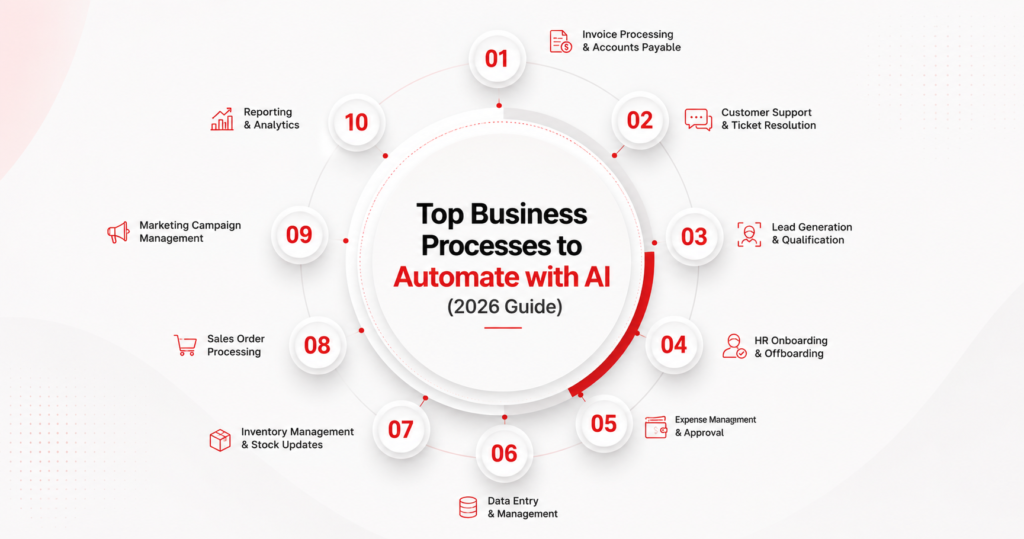
Artificial Intelligence is no longer a futuristic concept reserved for tech giants or Silicon Valley startups, it has become a practical business tool that is actively reshaping how companies operate, reduce costs, and scale productivity.
The real competitive advantage today is not just using AI, but knowing exactly which processes inside your business are actually worth automating, because not every task should be handed to machines and not every workflow benefits from automation in the same way.
In growing economies like Nigeria, where Small and Medium-sized Enterprises(SMEs) dominate and businesses constantly battle with rising operational costs, manual inefficiencies, customer service overload, and fragmented systems, the ability to correctly identify automation opportunities can be the difference between stagnation and scalable growth.
A Lagos-based business owner processing invoices manually, replying to hundreds of WhatsApp messages daily, or tracking inventory in spreadsheets is not just wasting time, they are losing strategic capacity that could be redirected into sales, marketing, or expansion.
Research published by the McKinsey Global Institute and Harvard Business Review consistently shows that organizations generate the greatest value from AI when they apply it to structured, repetitive, data-rich work while reserving human judgment for creativity, relationship-building, ethical decisions, and complex problem-solving.
As Karim R. Lakhani, Professor of Business Administration at Harvard Business School, writes in Harvard Business Review:
“AI won’t replace humans—but humans with AI will replace humans without AI.”
The Core Principle: What Makes a Process AI-Automation Ready?
A process is usually ready for AI automation when it is repetitive, rule-based, data-driven, and measurable. Rather than looking at the technology first, evaluate the process itself.
Ask yourself four simple questions:
- Does the process happen repeatedly?
- Does it follow predictable rules?
- Does it use digital data?
- Can success be measured?
For example, monthly invoice reconciliation, customer inquiries, order tracking, expense approvals, CRM records, spreadsheets, and API-driven workflows all meet these characteristics.
If you answer “yes” to all four questions, the process is a strong candidate for automation. Three “yes” answers usually indicate that AI should support humans rather than replace them. If two or more answers are “no,” the process is better left human-led for now.
Even when a process qualifies, avoid full automation if it requires emotional judgment, ethical decision-making, or sensitive human interaction. AI should assist people in these situations, not replace them.
Example: A retailer manually matching payment screenshots to customer orders every day would likely answer “yes” to all four questions. The task is repetitive, follows a consistent process, uses digital information, and has measurable outcomes. That makes it a strong automation candidate.
Interestingly, this four-question test closely aligns with findings published by the McKinsey Global Institute and Harvard Business Review. Both emphasize that organizations achieve the greatest returns from AI by focusing on structured, repeatable processes with clear rules, measurable outcomes, and strong human oversight for judgment-intensive work.
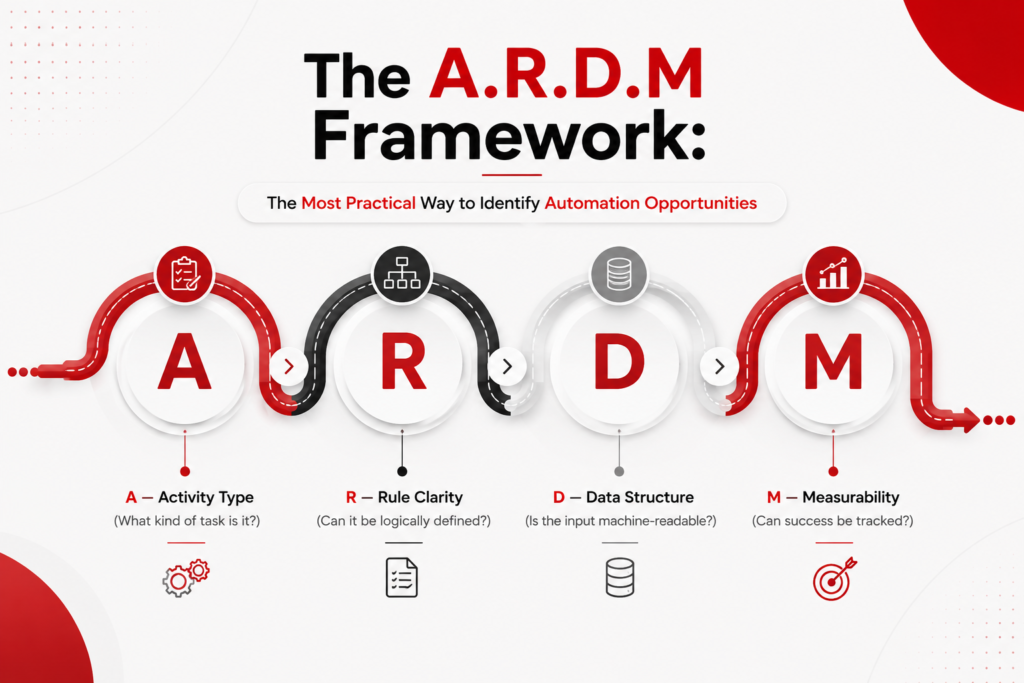
The A.R.D.M Framework: The Most Practical Way to Identify Automation Opportunities
To simplify global frameworks into something practical and usable, we can consolidate everything into a single decision model called the A.R.D.M Framework, which helps businesses evaluate whether a process should be automated, augmented, or left fully human-driven.
A — Activity Type (What kind of task is it?)
This evaluates whether the task is repetitive, structured, or creative in nature. Tasks like invoice processing, data entry, report generation, and customer FAQs fall into repetitive activity types, while negotiation, strategic planning, and emotional communication fall into creative or human-centered categories.
The more repetitive the activity, the higher the automation potential becomes. Higher repetition = higher automation potential.
R — Rule Clarity (Can it be logically defined?)
This checks whether the process can be broken down into predictable rules or “if-then” logic. Enterprise AI initiatives consistently begin by breaking complex workflows into smaller, clearly defined tasks before determining which steps can be automated and which require human judgment. This task-first approach is widely reflected in research from the McKinsey Global Institute and enterprise AI implementation guidance.
If employees consistently follow the same procedure with minimal variation, the process is likely rule-based and automatable.
D — Data Structure (Is the input machine-readable?)
AI systems depend heavily on structured or semi-structured data. If the process relies on spreadsheets, CRM systems, forms, emails, or digital documents, it is highly suitable for automation.
However, if the process depends heavily on handwritten notes, voice interpretation, or ambiguous human communication, additional preprocessing is required before automation becomes reliable.
M — Measurability (Can success be tracked?)
A process becomes automation-ready when its success can be measured objectively. Metrics like time saved, error reduction, cost per transaction, or customer response time indicate strong automation potential.
McKinsey highlights that processes without measurable KPIs are not suitable for enterprise AI deployment because performance cannot be optimized or validated.
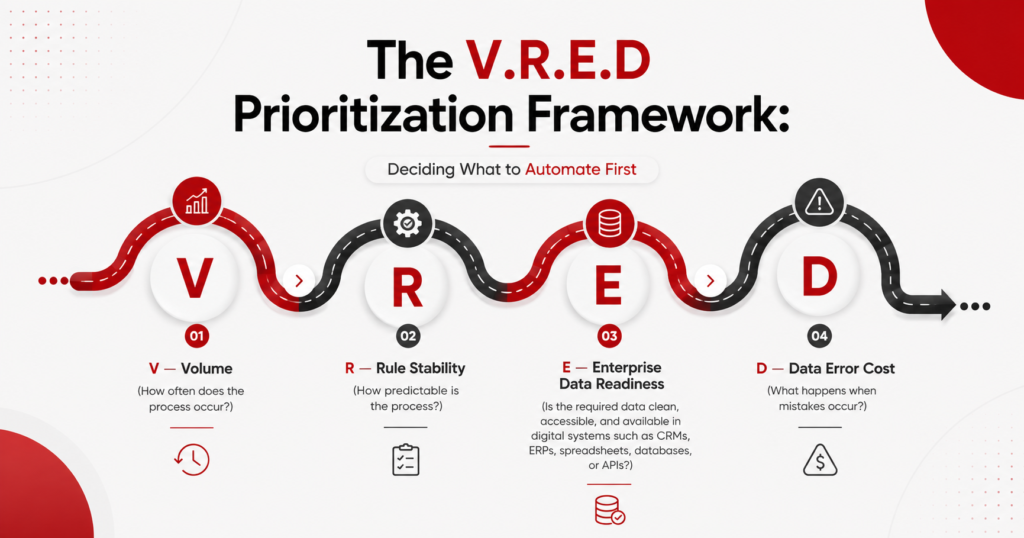
The V.R.E.D Prioritization Framework: Deciding What to Automate First
A.R.D.M tells you what can be automated. V.R.E.D tells you what should be automated first.
Not all automatable processes deliver the same return on investment. Some save a few minutes per week, while others can eliminate hundreds of hours of repetitive work annually. V.R.E.D helps identify the highest-impact opportunities.
Volume (V)
How often does the process occur? Tasks performed daily or hundreds of times each month typically generate the fastest automation returns.
Rule Stability (R)
How predictable is the process? Workflows with consistent rules and few exceptions are easier to automate reliably than processes that constantly require human judgment.
Enterprise Data Readiness (E)
Is the required data clean, accessible, and available in digital systems such as CRMs, ERPs, spreadsheets, databases, or APIs? Strong data foundations dramatically improve automation success rates.
Data Error Cost (D)
What happens when mistakes occur? Processes where errors create financial losses, compliance risks, operational delays, or customer dissatisfaction often provide the greatest value when automated.
The A.R.D.M + V.R.E.D Automation Decision Scorecard
To make automation decisions practical, we combine both frameworks into a single evaluation system: A.R.D.M → Determines if a process can be automated (Suitability) while V.R.E.D → Determines if it should be prioritized (Impact)
Together, they form a complete automation decision scorecard.
Phase 1: A.R.D.M (Automation Suitability Score)
| Criterion | Score 1 | Score 5 |
| Activity | Rare and unique | Highly repetitive |
| Rule Clarity | Constant exceptions | Clear, predictable rules |
| Data Structure | Messy and unstructured | Clean, digital, machine-readable |
| Measurability | Hard to measure | Easy to measure with KPIs |
A.R.D.M Interpretation: 16–20 → Automate (strong candidate), 11–15 → Augment (AI + human collaboration) and 4–10 → Keep manual (human-led)
Phase 2: V.R.E.D (Automation Priority Score)
| Factor | Score 1 | Score 5 |
| Volume | Rare | Daily / High volume |
| Rule Stability | Many exceptions | Very consistent |
| Data Readiness | Poor data | Clean digital data |
| Error Cost | Low impact | High financial/risk impact |
V.R.E.D Interpretation: 16–20 → High-priority automation opportunity, 11–15 → Strong candidate for future automation, 6–10 → Lower-priority opportunity and Below 6 → Not worth prioritizing yet
How to Use Both Together
Instead of guessing, organizations now evaluate automation using two questions:
- A.R.D.M → Can we automate this?
- V.R.E.D → Should we automate this first?
This ensures companies don’t just find automation opportunities — they prioritize the ones that create real business impact. This is exactly how organizations like Firstlincoln approach automation readiness when designing enterprise AI systems for clients.
Categories of Processes AI Can Automate (Real Business Breakdown)
To better understand automation opportunities, processes should not just be evaluated individually but grouped into functional categories that reflect how AI systems actually operate in real environments.
1. Cognitive Repetition Tasks
These are tasks that involve repeated mental processing such as sorting, classifying, or organizing information.
Examples include data entry, document categorization, and spreadsheet updates.
These are among the easiest tasks to automate using RPA (Robotic Process Automation) combined with machine learning systems.
2. Language and Communication Tasks
These involve natural language interpretation such as customer support, email responses, content drafting, and chatbot interactions.
Modern generative AI systems perform particularly well in language-based tasks because they can generate, summarize, classify, and transform text across a wide range of business contexts. Enterprise guidance from Microsoft and Google Cloud highlights customer support, content creation, document summarization, and knowledge management as common use cases.
3. Predictive and Analytical Tasks
These include fraud detection, demand forecasting, credit scoring, and customer churn prediction.
These tasks are highly dependent on structured data and statistical models, making them ideal candidates for machine learning models used in fraud detection, forecasting, customer analytics, and risk assessment across enterprise environments.
4. Multi-Step Workflow Automation
These involve complex business flows such as onboarding processes, invoice-to-payment systems, order fulfillment, and HR recruitment pipelines.
These are increasingly handled by agentic AI systems that can coordinate multiple tools and decisions across steps, a trend strongly emphasized in modern AI agent research. According to Microsoft, enterprise AI agents are increasingly being designed to coordinate multi-step workflows across multiple business applications while maintaining human oversight.
What AI Should NOT Automate (Critical for Accuracy and Trust)
One of the most overlooked aspects of automation strategy is understanding what should remain human-led. Not all efficiency improvements are beneficial if they compromise trust, ethics, or brand experience.
Research published in Harvard Business Review and the work of Thomas H. Davenport consistently argue that AI delivers the greatest value when augmenting human expertise rather than replacing human judgment—particularly in decisions involving ethics, empathy, creativity, or significant business risk.
AI should NOT fully automate certain processes. These include areas such as emotional conflict resolution like HR disputes or customer escalations, ethical or legal judgment where consequences are irreversible, highly creative brand strategy decisions that define identity, situations requiring deep empathy or cultural sensitivity, and processes where data quality is unreliable or inconsistent.
Instead, these should be handled through augmentation models where AI supports decision-making but humans retain final authority.
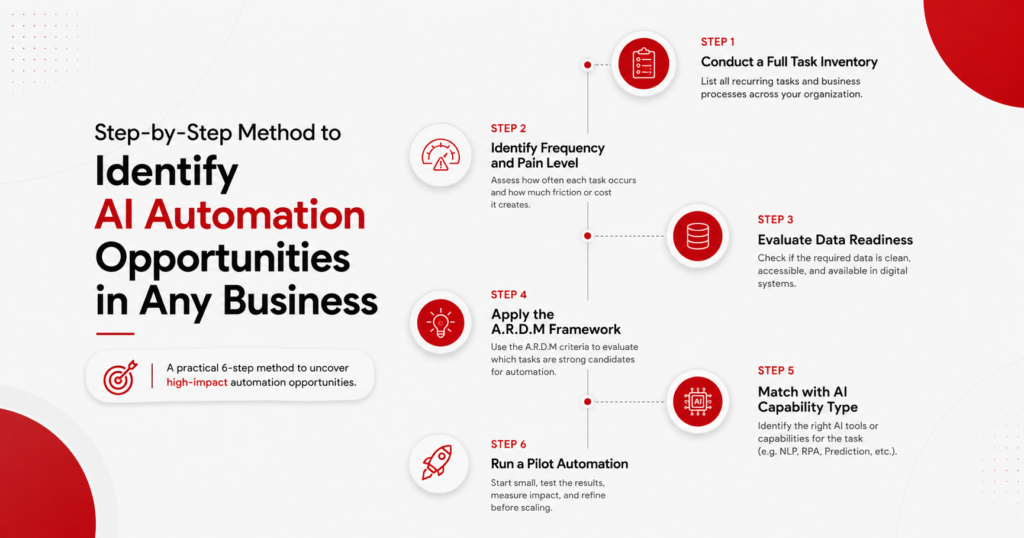
Step-by-Step Method to Identify AI Automation Opportunities in Any Business
A structured identification process ensures businesses do not automate randomly or inefficiently.
Step 1: Conduct a Full Task Inventory
Break down every department into micro-tasks instead of broad roles. Instead of “Marketing,” identify tasks like “posting Instagram captions,” “responding to DMs,” or “tracking campaign performance.” This level of granularity is essential for accurate automation mapping.
Once you’ve listed micro-tasks, validate them with process mining. Many organizations document how they think work happens. Process mining reveals how work actually happens.
As process mining research and enterprise platforms such as Celonis have demonstrated, organizations frequently discover hidden bottlenecks and undocumented workflows that traditional process mapping misses.
By analyzing operational data from systems like ERP, CRM, and transaction logs, these tools reconstruct workflows and expose: bottlenecks in operations , hidden delays between steps, undocumented manual workarounds and automation opportunities teams are unaware of
This adds a layer of objective truth to automation planning and prevents one of the most common mistakes in AI projects: automating assumptions instead of reality.
Step 2: Identify Frequency and Pain Level
Focus on tasks that occur daily or weekly and consume significant time or cause frustration. In most organizations, these “boring but necessary” tasks are the highest ROI automation candidates.
Step 3: Evaluate Data Readiness
Check whether the task uses structured digital systems or messy unstructured inputs. AI performs significantly better when data is consistent and accessible through systems like CRMs, spreadsheets, or APIs.
Step 4: Apply the A.R.D.M Framework
Score each task using Activity, Rule clarity, Data structure, and Measurability to determine automation readiness.
Step 5: Match with AI Capability Type
Different AI capabilities align with different tasks. Natural Language Processing (NLP) is best suited for text and communication tasks, Computer Vision (CV) handles document and image processing, Machine Learning (ML) supports prediction and classification, and Agentic AI enables multi-step workflows.
Step 6: Run a Pilot Automation
Start small with one process, measure performance improvements, and validate ROI before scaling across departments.
Real-World Examples
In Nigeria and similar emerging markets, AI automation is already transforming key sectors in practical and measurable ways.
- In fintech, fraud detection systems analyze transaction patterns in real time to detect anomalies and reduce financial crime
- In e-commerce, WhatsApp chatbots handle customer inquiries, order tracking, and product recommendations without human intervention
- In logistics, AI systems optimize delivery routes in congested cities like Lagos, reducing fuel costs and delays
- In SMEs, invoice processing automation reduces manual accounting workload and improves financial accuracy
A typical Lagos-based retail business using automation for inventory tracking and customer messaging can reduce operational workload by over 30 percent, freeing time for business development and customer acquisition.
Key Metrics to Measure Automation Success
Once automation is implemented, performance must be tracked using clear KPIs such as time saved per task or process, error reduction rate compared to manual execution, cost per transaction before and after automation, customer satisfaction scores (NPS or feedback ratings), and employee productivity improvements. Without measurement, automation becomes guesswork instead of strategy.
Final Insight: Stop Guessing. Start Mapping.
Most organizations do not fail at AI adoption because of technology. They fail because they automate the wrong processes.
Modern automation success depends on one thing: knowing exactly what to automate — and in what order.
If your business processes feel: scattered, manual, slow to scale, and difficult to track. The issue is rarely technology. It is process visibility and automation readiness clarity.
Next Step: Work With Firstlincoln
At this stage, most organizations already understand the theory — the real challenge is translating it into working systems inside their business.
At Firstlincoln, we help organizations move from uncertainty to structured AI transformation by mapping real business workflows, identifying automation-ready processes, designing AI + data systems, implementing enterprise automation solutions and building internal capability to sustain transformation.
You can begin with an AI Automation Readiness Assessment with one of our experts to understand what can be automated, what should not be automated and where AI will actually deliver ROI
Visit firstlincoln.net to contact our team to begin your automation assessment.
Firstlincoln helps organizations move from:
manual operations → intelligent systems
In the next phase of growth, the winners won’t be the companies with the most data or tools — but the ones that know how to turn their processes into intelligent, automated systems that scale.