
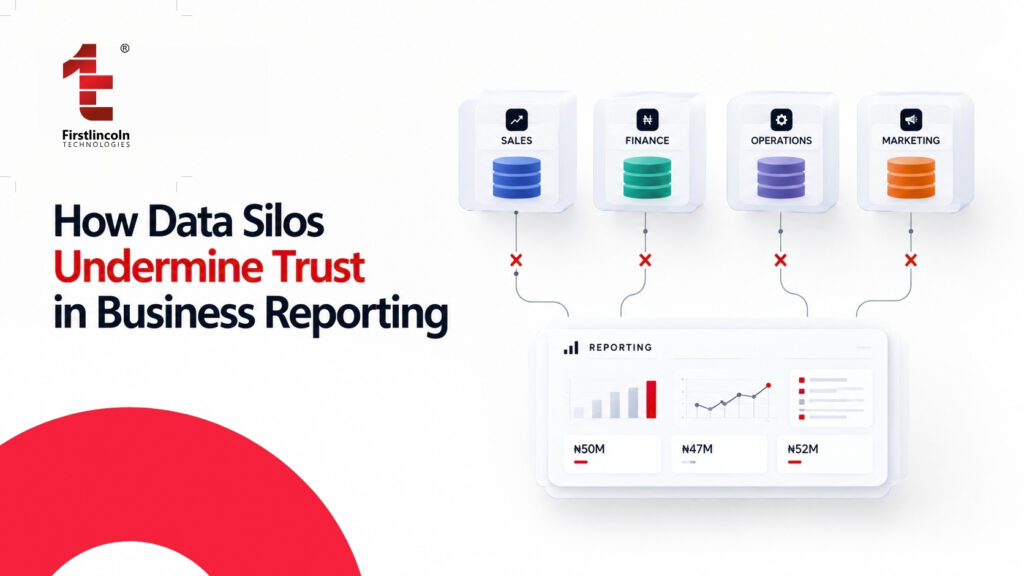
Your business may not have a reporting problem. It may have a data silo problem.
Imagine a leadership meeting where someone asks a simple question: How much did we sell last month?
Sales has one figure. Finance has another. Operations has a third. Everyone has a report to support their number. The problem is that nobody can immediately explain why the numbers disagree.
This is where a reporting problem becomes something more fundamental: a problem of trust in the data behind the report.
IBM’s explanation of data silos describes data silos as isolated collections of data that prevent information from being shared across departments, systems and business units. IBM also connects silos with fragmented and inconsistent data, duplicated work, operational inefficiency, weaker decision-making, and challenges for analytics and AI.
The important point is that the dashboard is often not where the problem begins. The problem begins much earlier, in how the business collects, stores, connects, governs and interprets its data.
What Is a Data Silo?
A data silo exists when information is isolated from the people, systems or processes that need to use it. The isolation can be organizational. Sales may maintain customer information in its CRM. Finance may maintain customer information in its accounting system. Operations may keep another version in an internal platform. Someone else may maintain a spreadsheet that has gradually become the unofficial source of truth.
It can also be technical. A business may have a CRM, ERP, payment platform, HR system, e-commerce application, databases and cloud services, but each system may store information differently and operate with limited connectivity to the others.
The systems themselves are not necessarily the problem. The problem is what happens between them. When information cannot move reliably across the business, teams begin creating workarounds. They export spreadsheets. They copy records. They maintain shadow databases. They manually reconcile reports.
Over time, the business does not simply have more data. It has more versions of the data.
When One Business Has Several Versions of the Truth
Consider a customer record. Sales may define a customer as anyone who has entered the CRM. Finance may define a customer as someone who has completed a transaction. Customer service may define a customer as anyone with an active support relationship. Marketing may count leads, prospects and customers separately. All four departments can produce accurate reports according to their own systems and definitions.
Yet leadership may still struggle to answer a basic question: How many customers do we actually have? This is where data silos become a business problem rather than simply a technology problem.
McKinsey’s research on master data management illustrates the scale of the issue. In a 2023 survey of more than 80 large global organizations, 80% of respondents reported that some divisions operated in silos, with their own data management requirements, practices, source systems and consumption behaviors. The research also found that 62% reported having no well-defined process for integrating new and existing data sources.
The lesson is not that every organization needs one enormous database. It is that organizations need consistent definitions, reliable data flows and clear ownership of important information. A business can have multiple systems and still have a trustworthy data environment. What it cannot easily have is multiple systems producing conflicting versions of critical business information without a way to reconcile them.
When Reporting Becomes Data Reconciliation
Reporting is supposed to help people understand what has happened so they can decide what to do next. But when data is siloed, reporting can quietly become a reconciliation exercise. Before an analyst can answer Why did revenue fall last month? they may first need to answer:
- 1. Which revenue figure is correct?
- 2. Which transactions are included?
- 3. Are refunds reflected?
- 4. Are payment settlements included?
- 5. Are cancelled orders excluded?
- 6. Which customer records are duplicates?
- 7. When was each dataset last updated?
- 8. Which system owns the underlying information?
The analyst is no longer primarily analyzing the business. They are repairing the path between the business and its data. That distinction matters. If a significant amount of reporting time is spent collecting, cleaning, matching and reconciling information from disconnected systems, the organization may have a data architecture problem hiding underneath its reporting process.
This is also why adding more dashboards does not necessarily solve the issue. A dashboard can present information beautifully. It cannot determine which of two conflicting source systems contains the correct customer record unless the underlying data architecture and governance provide an answer.
A Better Dashboard Cannot Fix Disconnected Data
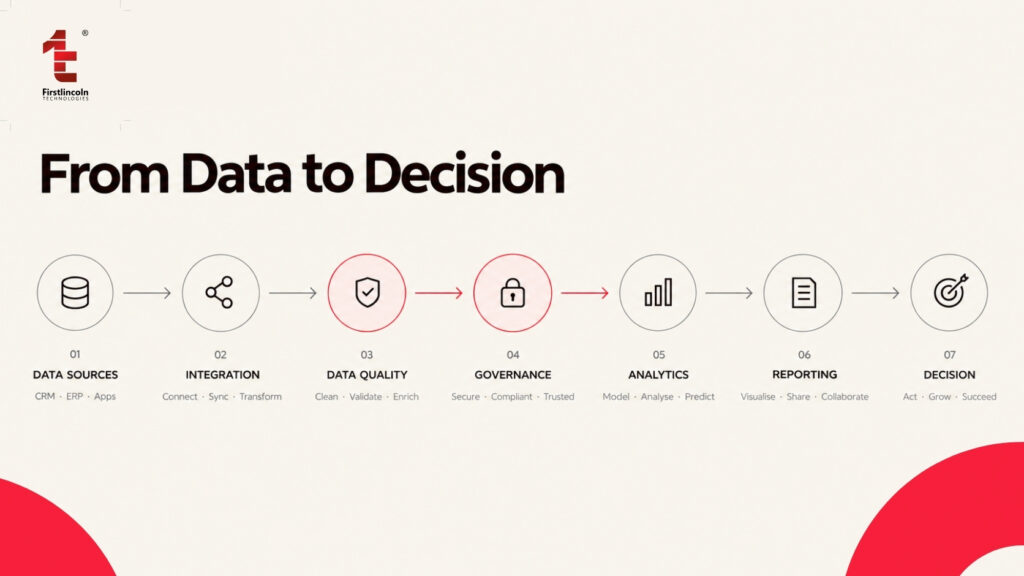
Businesses often respond to reporting problems by buying or building another dashboard. Sometimes that is appropriate. But visualization is only one layer of the data chain. A simplified version looks like this:
Data Sources → Integration → Data Quality → Governance → Analytics → Reporting → Decision
If the data entering that chain is fragmented, duplicated or inconsistently defined, improving the final visualization does not repair the earlier layers. You can create a sophisticated dashboard from bad inputs. You can also automate a report that is consistently wrong. The technology may be functioning exactly as designed. The business problem is that the system is producing an answer from information that was never properly connected or governed.
This is why Firstlincoln’s Essential Guide to Data Integration for Growing Businesses treats integration as more than simply moving information between systems. Data integration connects data from different sources so it can be combined, synchronized, transformed and made available for business use. But there is an important distinction: Integration creates connectivity. It does not automatically create trust. Trust requires the business to know what the data means, where it came from, who owns it, how it should be transformed and whether it meets the required quality standards.
Data Integration Is Necessary, But It Is Not the Whole Answer
Suppose a business connects its CRM to its finance system. That sounds like progress. But what happens when the CRM contains three records for the same customer? Or when Finance uses a different definition of “active customer”? Or when one system records revenue at the time of an order while another records it after payment? The systems are now connected. The disagreement remains.
This is why breaking down data silos requires more than connecting applications. It requires a combination of: Integration + Data Quality + Governance + Clear Ownership
Integration determines how information moves. Data quality determines whether the information is reliable enough to use. Governance establishes the rules around ownership, access, definitions, quality, security and usage. Together, these create the conditions for trustworthy reporting.
Microsoft’s guidance on data governance explains data governance in terms of ensuring that data used in operations, reporting and analysis is discoverable, accurate, trusted and protected. That is an important shift in how businesses should think about governance. Governance is not simply an IT compliance exercise. It is part of the infrastructure of business trust.
What Data Silos Do to Analytics
Analytics becomes significantly more valuable when analysts can work from connected, reliable information. But when data is siloed, analysts may see only fragments of the business. Imagine trying to understand customer profitability using customer information from a CRM, transaction data from Finance, support interactions from a customer service platform, product information from Operations, and marketing activity from another platform.
Individually, each dataset may be useful. Together, they can answer questions that none of the systems can answer alone. But only if they can be connected meaningfully.
Without that connection, analytics can become constrained by the structure of the systems rather than the questions the business actually wants answered. Instead of asking Which customer segments are becoming less profitable and why? the organization ends up asking Can someone combine these five spreadsheets first? That is a very different use of analytics.
Firstlincoln’s Data Analytics & BI services are relevant at this layer because analytics is ultimately about turning business data into information that can support better understanding and decisions. But the analytical layer depends on the quality and accessibility of the data beneath it. This is why modern analytics should not be viewed simply as “putting data into a dashboard.” The real work begins before the chart.
What Data Silos Do to Decision-Making
The most serious consequence of data silos is not that employees spend extra time preparing reports. It is that leaders can begin making decisions with incomplete or conflicting information. A CEO may see revenue increasing while cash collections are weakening. A COO may see strong order volumes while fulfillment delays are increasing. A sales leader may see growing leads while Finance sees declining conversion into paying customers.
None of these numbers necessarily has to be wrong. The problem is that each represents only part of the business. When those fragments are not connected, leadership can mistake a partial view for the complete picture.
IBM’s explanation of data silos similarly identifies compromised decision-making, degraded data quality, operational inefficiency and limited data value among the consequences of fragmented information. The result is a subtle but important organizational problem: People begin trusting the report they understand rather than the data the business actually needs. That is how spreadsheet workarounds become permanent.
The Governance Problem Behind the Reporting Problem
Once multiple departments create and maintain their own data, another question appears: Who is responsible for deciding what the data means? Consider something as simple as “customer.” Who owns the definition? Who determines the official customer identifier? Who decides whether duplicate records should be merged? Who determines which system is authoritative? Who is responsible when two systems disagree?
Without clear answers, every department can develop its own rules. That creates what might be called semantic fragmentation. The systems may technically exchange information, but the organization still does not share a common understanding of that information.
This is why data governance matters. Governance establishes the rules that allow data to remain understandable, controlled and trustworthy as it moves through the organization. It can cover ownership and stewardship, data definitions, quality standards, access permissions, security, lineage and provenance, retention, compliance, and accountability.
The goal is not to create bureaucracy around every spreadsheet. The goal is to establish enough structure around critical data that people can confidently use it for operations, reporting and analysis.
The Signs of a Data Silo Problem May Already Be Around You

- 1. Data silos rarely arrive with a warning saying, “Your enterprise data architecture is fragmented.” They usually appear as everyday operational frustrations. You may already have a silo problem if:
- 2. Different departments report different numbers for the same metric. Revenue, customer counts, inventory or performance figures change depending on which department produced the report.
- 3. Employees repeatedly copy information between systems. Someone exports a spreadsheet from one application and uploads it into another every week.
- 4. Reporting takes longer than analysis. Teams spend hours collecting and cleaning information before they can begin interpreting it.
- 5. People maintain shadow spreadsheets. Employees create their own “master” versions because they do not trust the official system.
- 6. Management meetings begin with arguments about the numbers. Instead of discussing what the data means, people spend the first part of the meeting deciding which dataset is correct.
- 7. Adding another software tool creates another data problem. The new system solves one operational need but creates another isolated source of information.
- 8. Customer information is scattered across departments. Sales, Finance, Operations and Customer Support each see different parts of the customer relationship.
- 9. AI projects immediately run into data problems. Teams discover that the information required by an AI system is fragmented, inaccessible, inconsistent or poorly governed.
These are not all proof of a data silo by themselves. But together, they are strong signals that the organization should examine how information moves through its systems.
Why Data Silos Become an AI Problem
The conversation becomes even more important when artificial intelligence enters the picture. AI does not remove the need for good data architecture. It increases it. An AI system may be capable of generating answers, identifying patterns, predicting outcomes or automating decisions. But it still depends on the information available to it. If the underlying information is fragmented, outdated, duplicated or poorly governed, the AI system may have incomplete context. That can affect the reliability and usefulness of its outputs.
This is one reason Most Companies Have a Data Problem, Not an AI Problem is an important part of Firstlincoln’s broader thinking around AI adoption. The issue is not that AI is incapable of creating value. The issue is that organizations sometimes try to place intelligence on top of an information environment that is not ready to support it. The same principle appears in The Hidden Reason Most AI Projects Fail: Businesses Don’t Know How to Organize Their Knowledge, where the focus is on the organizational knowledge scattered across systems, documents and other information sources.
The sequence matters: Disconnected Data → Poor Data Foundation → Weak Context → Limited Analytics and AI Reliability
AI should not be treated as a shortcut around data architecture. In many cases, AI makes the quality of that architecture more important.
What Should a Business Do About Data Silos?
The answer is not necessarily to replace every system. Nor does every business need one giant centralized database. The starting point should be the business problem created by the fragmentation. A practical approach is to begin with five questions:
1. Where does critical business data live?
Map the systems, databases, spreadsheets, applications and external platforms that contain information required for important decisions and processes.
2. Where does information break down?
Identify where employees manually copy, reconcile, transform or re-enter information. Those points often reveal the highest-value integration opportunities.
3. Which system should be trusted for what?
Not every system needs to own every piece of information. Define which source is authoritative for each critical data domain.
4. What rules govern the data?
Establish definitions, ownership, access controls, quality expectations and processes for resolving conflicting information.
5. What business outcome should improve?
Do not start with: “Which integration technology should we buy?” Start with: “Which business process or decision should become better because these systems can work together?” That shift keeps technology connected to business value.
The Data Foundation Behind Analytics and AI
Breaking down data silos is not a matter of adding one more technology. It usually requires several connected capabilities working together.
Data engineering provides the architecture, pipelines and infrastructure required to move and manage data reliably.
Data integration connects information across applications, databases and other sources so it can be brought together for business use.
Data governance establishes the ownership, definitions, quality standards and controls needed to make that information trustworthy.
Analytics and BI turn that information into visibility, helping organizations understand what is happening across the business.
Data science can apply statistical and predictive methods to identify patterns, estimate outcomes and support more complex decisions.
AI can then use these capabilities and the data behind them to support intelligent applications, automation, prediction and other business use cases.
These are not completely separate stages, and they do not always happen in a fixed sequence. They are interconnected parts of a broader data and technology environment.
That distinction matters because businesses often jump straight to the last question:
“How can we use AI?”
A better starting point is:
“Can our systems provide the reliable, accessible and well-governed information that the AI use case requires?”
If the answer is no, the problem may not be the AI model. The constraint may be the data foundation underneath it.
This is where Firstlincoln’s approach to data and technology becomes relevant. Rather than treating integration, analytics, data engineering and AI as isolated projects, the focus is on understanding the business problem first, then determining what the underlying technology environment needs to support the desired outcome.
That may mean redesigning data pipelines, integrating disconnected systems, improving the analytical environment, working with larger and more complex datasets, applying data science, or building AI into existing business processes.
Firstlincoln’s Data Engineering services support the infrastructure and data pipelines behind reliable data environments, while its Data Analytics & BI services focus on turning business information into usable insight. Where scale and complexity demand it, Big Data Analytics addresses larger and distributed data environments, while Data Science and Artificial Intelligence support more advanced analytical and intelligent applications.
The important point is not the number of technologies involved.
It is whether they work together to solve the business problem.
Reliable data creates the foundation. Integration makes information usable across systems. Governance creates trust. Analytics creates visibility. Data science creates deeper understanding. AI can build intelligence on top of it.
The Real Reporting Problem
The next time a leadership team sees two conflicting numbers on two different reports, the instinct may be to ask: Which report is wrong? A better question may be: Why can the business produce two different answers to the same question in the first place?
That question moves the conversation away from the dashboard and toward the systems underneath it. Because reporting is only as trustworthy as the data pipeline behind the report. And that pipeline includes much more than visualization. It includes how information is collected, stored, integrated, transformed, governed, analyzed and ultimately used to make decisions.
This is why data silos deserve attention. They do not simply make information harder to access. They can weaken the organization’s ability to agree on what is happening inside the business. And when people stop trusting the numbers, reporting becomes slower, decisions become harder, and technology investments become more difficult to translate into business value.
Where Firstlincoln Fits
Firstlincoln approaches data and technology from the business problem backward. The objective is not to connect systems simply because they can be connected. It is to understand where fragmented information is creating operational friction, reporting uncertainty, inefficient processes or limitations on analytics and AI, then design the appropriate technical foundation around that problem.
That may involve data engineering. It may involve integration. It may require analytics and BI. It may involve data science, big data architecture or AI. The right answer depends on the organization’s systems, data environment, business objectives and level of maturity.
The principle remains the same: Do not build more intelligence on top of information you cannot trust.
Start with the data. Understand where it lives. Understand how it moves. Understand who owns it. Establish the rules that make it trustworthy. Then build the reporting, analytics and intelligence that the business actually needs.
Your business may not need another dashboard. It may need to connect and govern the data underneath the dashboards you already have. Because when every department has its own version of the truth, better reporting begins with creating a stronger foundation for one trusted view of the business.