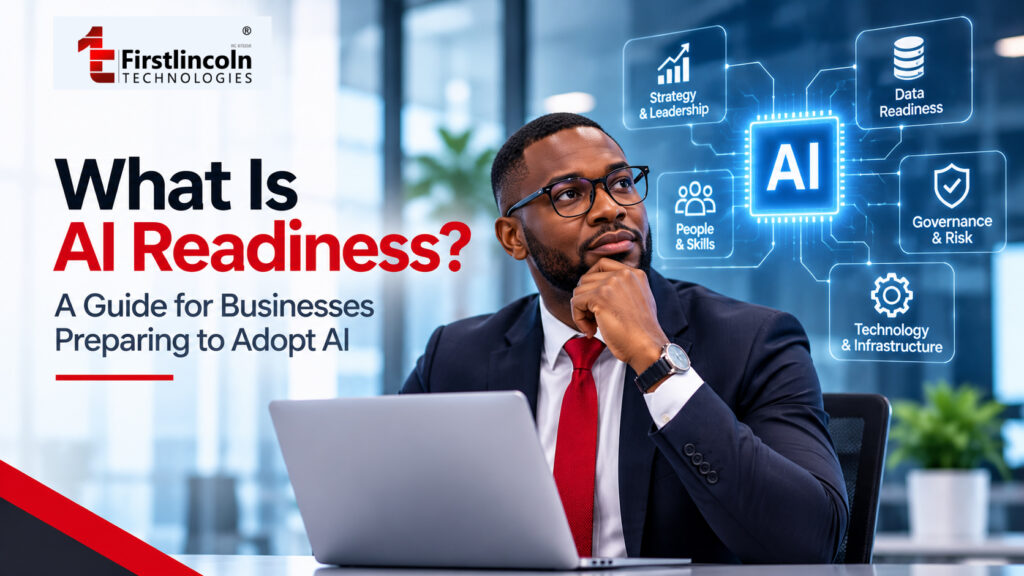
A business can invest in artificial intelligence, subscribe to advanced AI platforms and hire technical specialists, yet still struggle to make AI useful in its daily operations.
The problem is often not the technology itself, but whether the organisation has the right foundations to use it effectively.
According to AI Singapore’s AI Readiness Index (AIRI), organisational readiness involves five interconnected areas: leadership and culture, ethics and governance, business value, data foundations, and infrastructure and standards. These areas help businesses understand their current capabilities and identify what needs to improve before adopting AI.
For businesses, this highlights an important distinction: being interested in AI is not the same as being prepared to use it.
AI readiness involves understanding where AI can create value, whether existing systems can support it, whether employees have the necessary skills and whether appropriate safeguards are in place.
This guide explores what AI readiness means, why it matters, the key areas businesses should assess and how organisations can prepare for successful AI adoption.
What Is AI Readiness?
AI readiness refers to how prepared an organisation is to adopt, implement, manage and use artificial intelligence effectively and responsibly.
It considers whether a business has the strategy, data, technology, infrastructure, workforce capabilities, processes and governance needed to support its intended AI applications.
For example, a company planning to use AI to improve customer service should consider whether its customer information is accessible, its systems can support integration, and employees know how to review AI-generated responses.
These preparations help businesses move beyond experimenting with AI towards using it in their daily operations.
In simple terms, AI readiness means preparing the business before expecting artificial intelligence to deliver results.
Why Is AI Readiness Important for Businesses?
Adopting AI without understanding an organisation’s existing capabilities can lead to avoidable problems. A business might purchase an AI solution only to discover that its data is unreliable, employees are unprepared or the intended process is unsuitable for automation.
Assessing readiness helps businesses identify these challenges before committing significant resources.
1. It helps identify valuable AI opportunities
Not every business activity requires artificial intelligence. Technology adoption should begin with a business problem, not simply because a particular tool is available or competitors are using it.
A readiness assessment can help identify opportunities to automate repetitive administrative activities, analyse customer behaviour and purchasing patterns, improve demand forecasting, support customer service operations, extract information from large document collections, and identify unusual patterns in financial transactions.
The objective is to determine which opportunities offer meaningful value and whether the organisation can support them.
2. It reduces implementation problems
AI initiatives depend on several business capabilities working together. Disconnected systems, inconsistent data, unclear responsibilities and limited technical resources can complicate implementation.
Assessing readiness helps organisations identify weaknesses that could affect their intended AI applications and address the most important ones early.
3. It helps businesses plan their investments
AI implementation involves more than software subscriptions or development costs. Businesses may also need to invest in data preparation, system integration, employee training, infrastructure, security and ongoing maintenance.
Understanding these requirements helps decision-makers plan realistic budgets and avoid underestimating the resources needed to sustain an AI solution.
4. It supports responsible AI adoption
AI systems can introduce risks involving data privacy, security, inaccurate outputs, bias and accountability.
The ISO/IEC 42001:2023 Artificial Intelligence Management System Standard provides requirements for establishing and continually improving an organisational AI management system. It offers a structured approach to managing AI-related risks and opportunities.
Businesses should therefore consider governance and oversight before AI becomes deeply embedded in their operations.
Six Key Areas of AI Readiness Every Business Should Assess
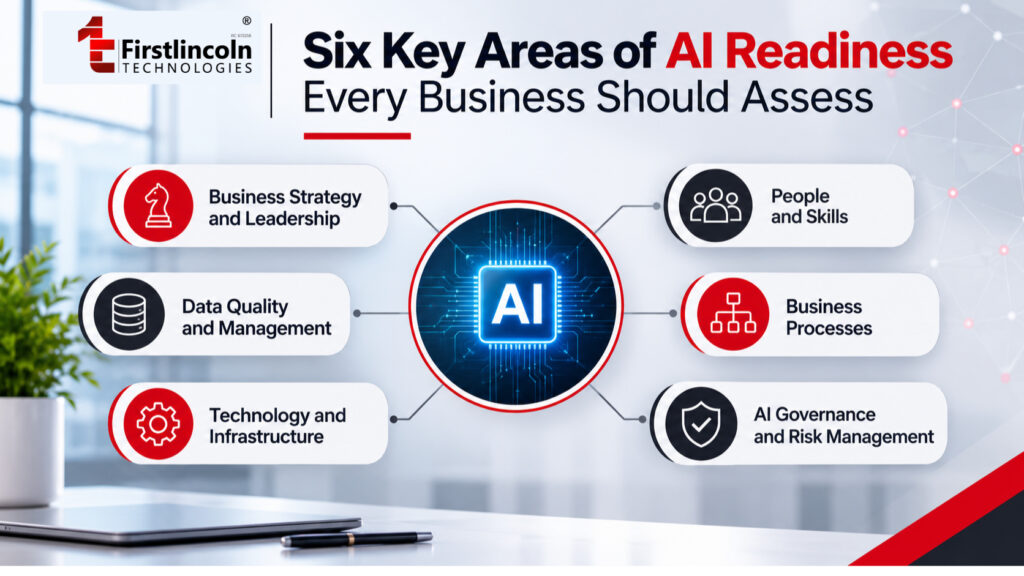
AI readiness is not determined by one technology requirement. It depends on how well different parts of an organisation work together.
The following six areas provide a practical framework for evaluating business preparedness.
1. Business Strategy and Leadership
AI adoption should have a clear business purpose. Before investing in AI, leadership teams need to understand what they want the technology to improve and how it supports wider organisational objectives.
Businesses should consider: what problems they are trying to solve, which departments could benefit from AI, what outcomes would justify the investment, who will oversee AI initiatives, and how success will be measured.
Leadership involvement is important because AI can affect departmental operations, employee responsibilities and business decisions. Without clear direction, organisations risk experimenting with multiple tools without a meaningful strategy.
2. Data Quality and Data Management
Data is one of the most important foundations of AI readiness. AI systems rely on information to generate predictions, identify patterns and support decisions. Incomplete, outdated or inconsistent data can affect the usefulness of their outputs.
Businesses should assess where important business data is stored, whether information is accurate and up to date, whether departments use consistent data definitions, whether existing systems can exchange information, who is responsible for managing important datasets, and whether appropriate access controls are in place.
For example, a company planning to introduce AI-powered sales forecasting needs reliable historical sales information. If records are incomplete or customer information is scattered across disconnected systems, those issues may need to be addressed first.
Businesses do not need to make every dataset perfect before adopting AI. They need to identify and prepare the information required for their intended application.
For more information, read Firstlincoln’s guide to data integration for growing businesses.
3. Technology and Infrastructure
An organisation may have reliable data and a clear AI strategy but still lack the infrastructure required for implementation.
Existing software, networks, cloud environments and computing resources influence how AI solutions can be introduced and maintained.
Businesses should examine whether: existing systems can integrate with AI applications, computing resources can support the intended workload, cloud or on-premises infrastructure is appropriate, systems can handle expected data volumes, security measures support AI integration, and deployed solutions can be maintained and monitored.
Not every organisation needs to build its own AI infrastructure. Some businesses may benefit from existing AI applications, while others may require custom development or integration with enterprise systems. The right approach depends on the business problem, technical requirements and available resources.
4. People, Skills and Organisational Culture
AI adoption is not exclusively a technical responsibility. Employees and managers need to understand how AI affects their work, where it can help and where human judgement remains necessary.
Businesses should consider employee awareness, access to training, technical expertise, management support and clearly defined responsibilities.
For instance, introducing an AI assistant into a customer service department does not automatically improve customer experience. Employees must know how to review generated responses, identify inaccurate information and handle situations requiring human intervention.
AI literacy should therefore extend beyond technical teams to employees and managers across the organisation.
5. Business Processes and Operational Readiness
AI works within business processes. If those processes are poorly understood or unnecessarily complicated, introducing AI may simply reproduce existing problems.
Before automating a workflow, businesses should understand how the work currently happens.
Important questions include: considerations include whether the process is clearly documented, which activities are repetitive, where delays or bottlenecks occur, what information the process requires, which decisions need human approval, and how AI outputs will enter existing workflows
Consider a business planning to automate invoice processing. It should first understand how invoices are received, verified and approved, and how records are transferred into its accounting system.
This helps determine which activities AI can support and which responsibilities should remain with employees. The goal is not to automate everything, but to identify where AI can improve an existing business activity.
6. AI Governance, Security and Risk Management
Businesses need clear rules for how AI systems are selected, accessed, used and monitored.
Without appropriate governance, employees may introduce unapproved tools, share sensitive information with external platforms or rely on outputs that have not been verified.
AI governance should address: data privacy and protection, access permissions and information security, accuracy, reliability and potential bias, human oversight and accountability, third-party AI providers, and ongoing performance monitoring.
The NIST AI Risk Management Framework provides voluntary guidance for incorporating trustworthiness considerations into the design, development, use and evaluation of AI systems.
Businesses can use frameworks like this to develop a more structured approach to identifying and managing AI-related risks.
How Can a Business Assess Its AI Readiness?
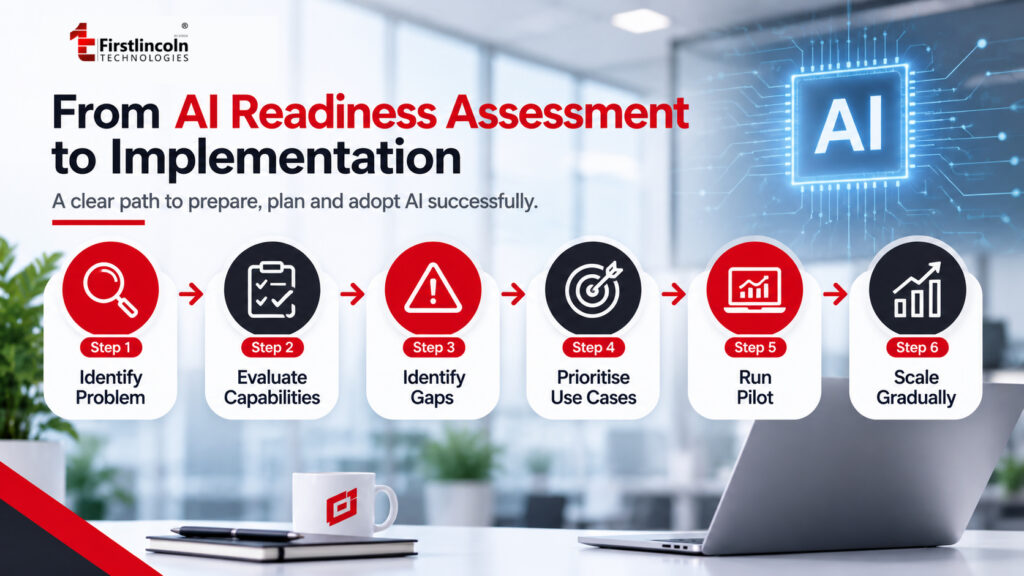
Understanding the different areas of AI readiness is useful, but organisations also need a practical way to evaluate their current position.
A readiness assessment should begin with the specific business opportunity the organisation wants to pursue.
Step 1: Identify the business problem
Determine what AI is expected to improve. This could involve customer service, business data analysis, repetitive administrative work or demand forecasting.
Avoid choosing an AI tool before understanding the problem it is supposed to solve.
Step 2: Evaluate existing capabilities
Assess the organisation across the six readiness areas: six readiness areas: business strategy and leadership, data quality and management, technology and infrastructure, people and skills, business processes, and governance and risk management.
Identify existing strengths and areas that need improvement.
Step 3: Identify important gaps
Not every weakness needs immediate attention. Prioritise gaps according to how much they could affect the intended AI application.
For example, a business introducing an internal AI knowledge assistant may need to prioritise document organisation, information access and data permissions. An organisation exploring predictive analytics may need to focus more on historical data quality and integration.
Step 4: Prioritise suitable AI use cases
Compare potential applications based on expected business value, implementation complexity, data availability, technical requirements, operational risks and available skills.
Start with an opportunity that offers value but is realistic given the organisation’s current capabilities.
Step 5: Run a controlled pilot
Test the selected application within a defined business process before introducing it across the organisation.
Establish what the system should accomplish, who will use it and how performance will be evaluated. Monitor accuracy, reliability, employee feedback and operational impact.
Step 6: Improve and scale gradually
Use the pilot results to identify what needs improvement. This may involve better data integration, additional training, process changes or stronger governance controls.
Expand the application when there is sufficient evidence that it works within the intended business environment.
Signs Your Business May Not Be Ready for AI
Certain organisational challenges may indicate that additional preparation is needed before introducing AI.
| Warning sign | What it may indicate |
| Business data is scattered across disconnected systems. | Data integration challenges. |
| Departments disagree about business figures. | Inconsistent data quality or definitions. |
| Nobody has identified a clear AI use case. | Lack of strategic direction. |
| Employees do not understand how AI works. | Insufficient AI literacy and training. |
| Existing processes are poorly documented. | Operational readiness gaps. |
| Nobody is responsible for AI oversight. | Weak governance and accountability. |
| AI-generated information is accepted without verification. | Insufficient human oversight. |
These warning signs do not automatically mean a business cannot adopt AI. They indicate areas that should be investigated and improved based on the intended application.
How Firstlincoln Helps Businesses Prepare for AI Adoption
Preparing for AI adoption requires an understanding of how business operations, data, infrastructure and people work together.
Firstlincoln Technologies provides technology and data science capabilities that support organisations exploring and implementing AI solutions.
Its Artificial Intelligence services include AI strategy and consulting, enterprise AI integration, intelligent automation, predictive analytics, natural language processing and computer vision.
Its published AI development methodology also covers discovery and data audits, model architecture design, training and validation, and production deployment and monitoring.
For businesses still evaluating their options, the starting point is to understand their existing environment, identify valuable opportunities and establish what needs to be in place before implementation.
For organisations already experimenting with AI, the priority may be improving data foundations, integrating systems or developing the technical and governance capabilities needed to move beyond isolated pilots.
The right approach depends on each organisation’s current position and objectives.
Conclusion: AI Readiness Starts Before AI Implementation
AI readiness is about preparing an organisation to use artificial intelligence in ways that support real business objectives.
It requires more than access to technology. Businesses need clear strategic direction, reliable data, suitable infrastructure, capable employees, effective processes and appropriate governance.
Organisations do not need to have everything figured out before taking their first step. However, they should understand their strengths, recognise their limitations and address the gaps that could affect implementation.
By approaching AI adoption strategically, businesses can move beyond experimentation and build practical AI capabilities that deliver meaningful value.
If your business is considering AI adoption, start by examining the foundations that will determine whether the technology can deliver the results you expect.