
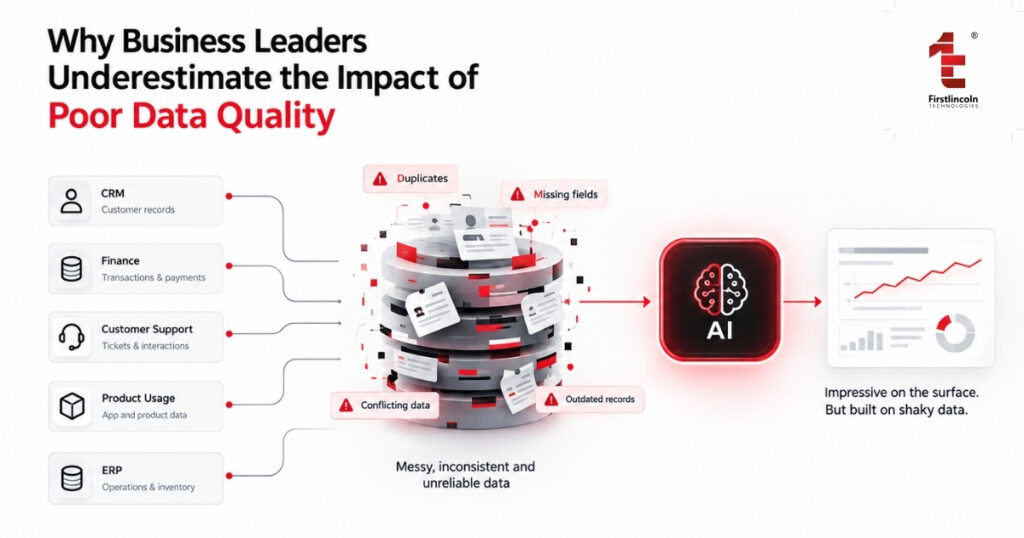
An AI pilot can look impressive while the data environment underneath it is quietly working against it. That becomes clear when the system moves from a controlled test into everyday business operations.
Customer records come from multiple systems. Definitions differ between departments. Some information is incomplete or outdated. Data arrives at different times. And processes that were manageable with human oversight suddenly have to support automated decisions at scale.
This is not just a technology problem. It is a data quality problem. This is part of a broader challenge: many organizations have a data problem before they have an AI problem.
Gartner’s research on the lack of AI-ready data makes the issue particularly clear. In a 2025 survey of more than 1,200 data-management leaders, 63% said their organizations either did not have or were unsure whether they had the right data-management practices for AI. Gartner also warns that AI-ready data requires more than traditional data management because AI systems have specific requirements around the data they consume.
The implication for business leaders is straightforward: Having data is not the same as having data that is ready for AI.
AI Can Expose Problems Your Reports Hide
Businesses have always operated with imperfect data. An analyst can discover a duplicate customer record. Finance can reconcile two figures before sending an executive report. A customer service manager can correct an incorrect record after speaking with the customer.
Human intervention can hide weaknesses in the underlying data environment. AI makes those weaknesses harder to ignore.
When an AI system depends on information from multiple business processes, inconsistencies can influence what the system learns, what it retrieves, and what it produces.
IBM describes AI data quality as the degree to which data is accurate, complete, reliable and fit for use throughout the AI lifecycle. It also highlights factors such as representativeness, bias, label accuracy and irrelevant variations that can affect model behaviour. IBM’s explanation of AI data quality
That is why the question is no longer simply whether a business has enough data. The more important question is: Is the data reliable enough for the decision the AI is expected to support?
Why AI Pilots Can Create False Confidence
A successful pilot is valuable, but it does not automatically prove that an organization is ready to operate AI at scale.
During a pilot, teams can work with a relatively controlled dataset, a narrow use case and close human oversight. Production is different.
The AI may suddenly have to work with information from several systems, changing customer behaviour, inconsistent records, new data sources and processes that were never designed with AI in mind. This is where data integration becomes critical: disconnected systems can make reliable information difficult to access and reconcile.
BCG’s research into scaling GenAI in information services identifies data preparation and management, systems integration, organizational capability and output accuracy among the major barriers organizations face when moving GenAI solutions toward scale. BCG’s research on scaling GenAI
The lesson is not that pilots are misleading. It is that pilot success and production readiness are two different questions.
A model can perform well under controlled conditions while the wider data environment remains unprepared for continuous operational use.
Data Quality Is More Than Clean Data
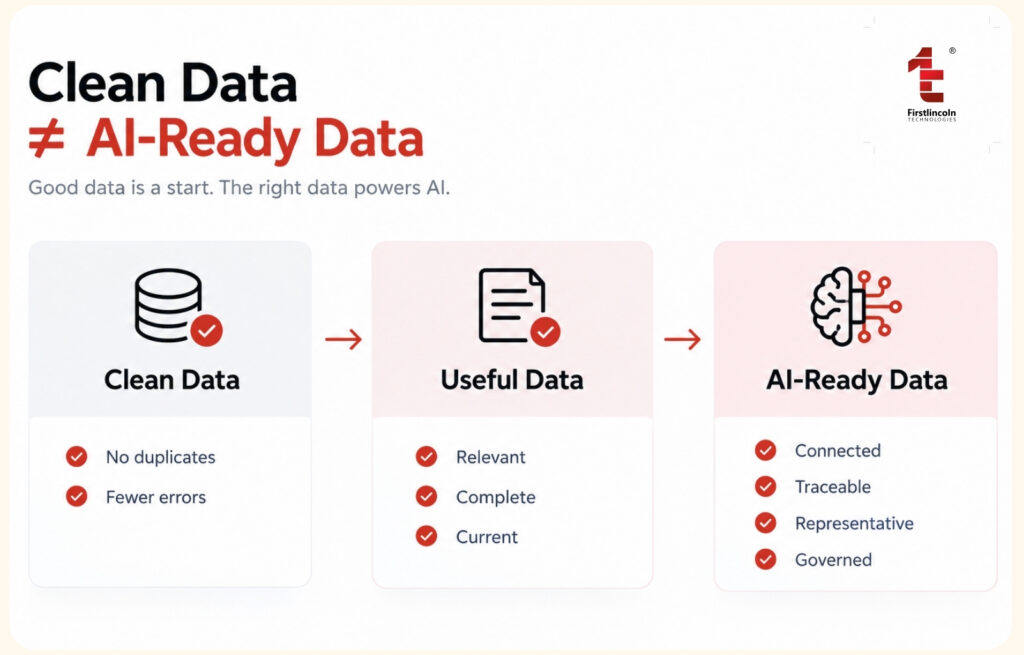
Data quality is often reduced to simple tasks such as removing duplicates, correcting errors or filling missing fields.
Those things matter. But AI introduces a broader definition of quality. Data may need to be consistent across systems, relevant to the specific use case, sufficiently complete, traceable, representative of real operating conditions and available when the decision needs to be made.
Gartner makes an important distinction here: high-quality data by traditional standards is not automatically AI-ready data. What makes data suitable depends on the specific AI use case, including the patterns, exceptions and context the system needs to understand. Gartner’s guide to AI-ready data
Consider a customer-service AI system. A dataset may be considered clean because duplicate records have been removed and missing fields have been corrected.
But if it does not contain the customer interactions, product history or recent service issues relevant to the AI’s task, the data can still be unsuitable for that particular use case.
Clean data is not necessarily useful data. And useful data is not necessarily AI-ready data.
What Happens When Data Quality Breaks
Imagine a company using AI to identify customers who may be at risk of leaving.
The system receives customer information from the CRM, payment history from finance, support interactions from a service platform and product-usage information from another application.
Each system may work perfectly well on its own. But what happens if the same customer has different identifiers across those systems?
What happens if payment information arrives later than expected?
What happens if Sales and Customer Service use different definitions for an “active customer”?
The model may still function. But it is now reasoning over an incomplete or inconsistent representation of the customer.
This is where data quality becomes a business issue rather than simply a technical one.
Poor inputs can lead to unreliable outputs. Those outputs then require additional human validation. More validation reduces the expected efficiency of automation. As confidence declines, teams become less willing to rely on the system for important decisions.
The problem is no longer simply whether the AI works. It is whether the business can trust it enough to use it.
The Mistake Leaders Make
When an AI initiative produces disappointing results, the instinct can be to change the model, switch vendors or look for a more advanced AI platform.
Sometimes those changes are necessary. But they should not automatically be the first response.
The first question should be: What is happening to the data between the source systems and the AI system?
Gartner’s research found that many organizations lack confidence that their existing data-management practices are sufficient for AI. It also recommends treating AI-ready data as an ongoing practice that evolves with specific AI use cases rather than as a one-time preparation exercise. Gartner’s research on AI-ready data and data-management practices
That changes the way leaders should think about AI investment.
The question is not simply: “Which model should we buy?”
It is: “Can our data environment consistently provide the information this AI use case needs?”
What AI-Ready Data Actually Requires
There is no single database or platform that automatically makes an organization AI-ready. The requirements depend on what the organization wants the AI system to do.
A business beginning with an internal knowledge assistant may need reliable documents, metadata, permissions and retrieval mechanisms. For organizations exploring enterprise knowledge systems, structuring and governing internal information becomes an important part of AI readiness.
A business building predictive models may need historical records, representative patterns, consistent labels and reliable operational data.
An organization using AI across customer operations may need connected information from CRM, transactions, support and other systems.
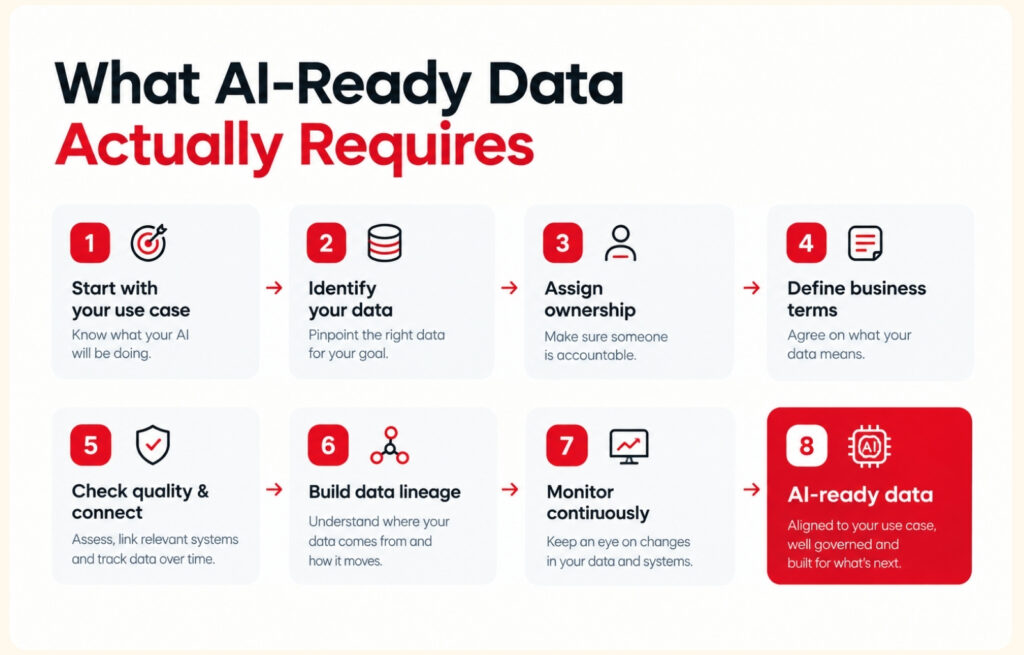
The starting point is therefore the use case.
From there, businesses can identify the required data, establish ownership, define important business terms, assess quality, connect relevant systems, document data lineage and monitor how information changes over time.
Gartner recommends this use-case-driven approach, emphasizing that AI-ready data must be aligned to the requirements of the specific AI initiative and supported by appropriate qualification and governance. Gartner’s AI-ready data framework
IBM similarly recommends profiling data early, understanding how it moves through pipelines, establishing data lineage and continuously monitoring quality as operating conditions change. IBM’s research and guidance on AI data quality
The important word is continuously. Business data does not stay still. Customers change. Products change. Processes change. Systems change. Data quality therefore cannot be treated as a one-time cleanup project.
What Business Leaders Should Do Differently
Before investing further in an AI initiative, leaders should examine the data foundation supporting it. Start with the business decision the AI is expected to improve.
Then identify the information required to support that decision and trace where it comes from.
Look for conflicting definitions, incomplete records, disconnected systems, outdated information and unclear ownership.
From there, prioritize the problems that could materially affect the AI use case. That might mean improving the quality of one critical dataset. It might mean integrating customer and transaction systems.
It might mean establishing ownership for an important data domain. It might mean redesigning a pipeline so information reaches the AI system consistently.
The goal is not to make every piece of data in the organization perfect before adopting AI.
The goal is to make the data that matters for each AI use case reliable, relevant, accessible and governed.
The FirstLincoln Perspective
AI adoption is moving the conversation about data from reporting to decision-making. For years, businesses could tolerate manual reconciliation because a person was ultimately responsible for checking the numbers.
As organizations introduce automation and AI into more business processes, that tolerance becomes harder to maintain.
The data foundation has to support not only dashboards and reports, but systems that can interpret information, generate outputs and increasingly participate in business workflows.
That is why FirstLincoln approaches AI readiness from the foundation upward.
Data engineering, integration, data quality and governance are not separate from AI strategy. They are part of what makes AI strategy executable.
The Real AI Readiness Question
The future of AI will not be determined by access to powerful models alone. It will also depend on whether businesses can provide those models with reliable information in the right context, at the right time, and under the right controls.
So before asking:
“Which AI solution should we use?”
business leaders should ask:
“Is our data environment ready to support the decisions we want AI to make?”
If the answer is unclear, another model may not be the solution.
The better starting point is to understand the data behind the decision, identify where quality and connectivity break down, and build the foundation required to make that information dependable.
Because AI does not make weak data foundations disappear.
It makes the consequences of those weaknesses harder to ignore.