A growing business usually creates more data. More customers. More transactions. More employees. More departments. More software. More reports. More dashboards.
But there is a point where having more data does not necessarily make decision-making easier.
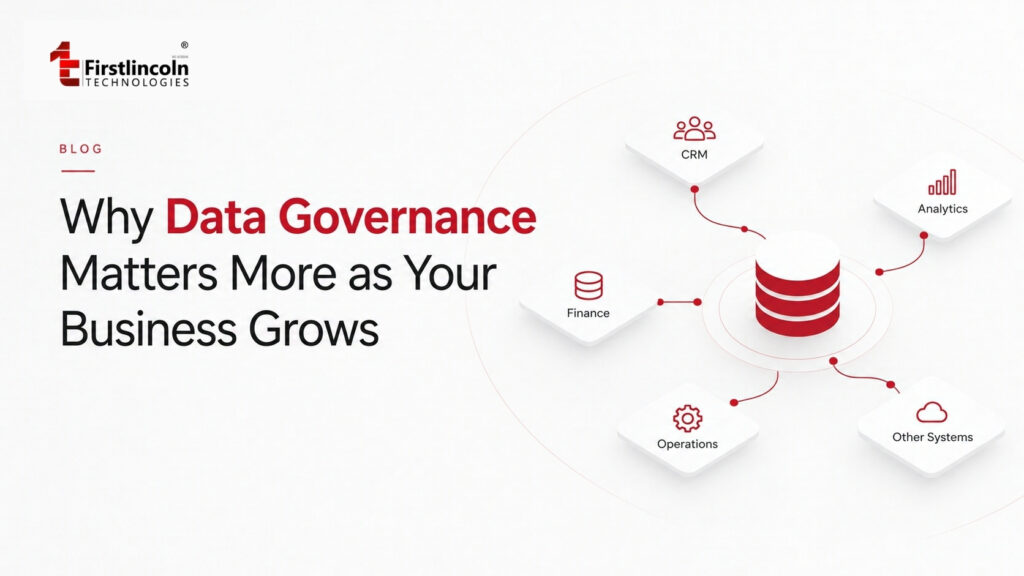
You may have customer information in your CRM, financial data in your accounting system, operational records in another platform and dashboards pulling information from several sources.
Yet when leadership asks a simple question like: “How many active customers do we have?”
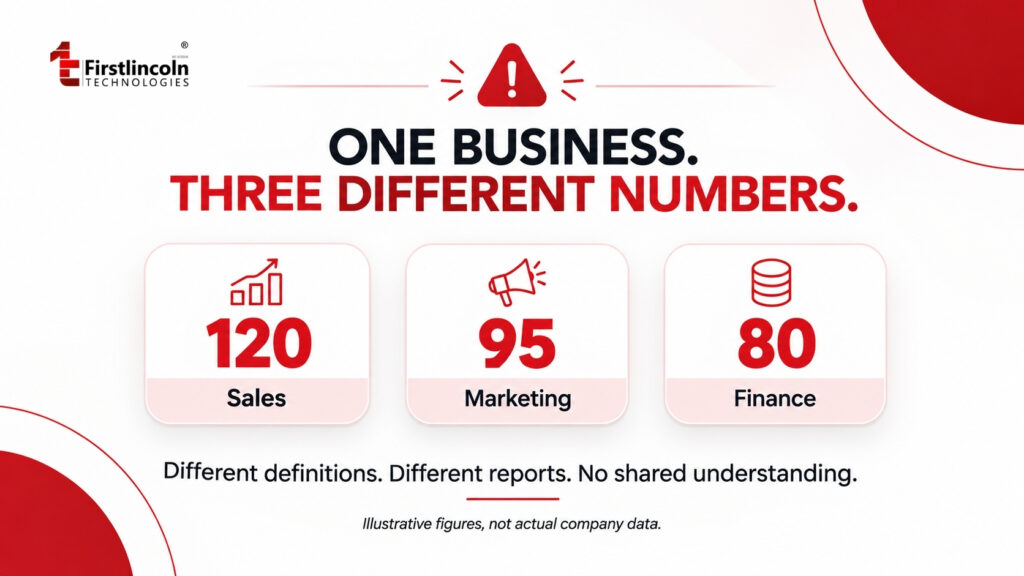
Sales has one number. Marketing has another. Finance has a third. Everyone has data. But nobody has agreed on what the number should actually mean. That is where data governance becomes important.
According to Microsoft’s data governance guidance, governance involves the processes, policies, roles, metrics and standards that help organizations manage information effectively while maintaining its security, accuracy and usability.
But for a growing business, the bigger question is not simply “Do we have data?”
It is:
Can the people making decisions trust what the data means, where it came from and who is responsible for it?
What Is Data Governance in Practical Terms?
Data governance is the framework a business uses to establish ownership, definitions, standards, access rules and accountability around the data it depends on.
It helps answer questions such as who is responsible for the data, what a particular business term actually means, and which system should be treated as the authoritative source. It also clarifies what quality standards the data should meet, who can access or change it, and what happens when an important definition changes.
IBM’s explanation of data governance similarly connects governance with data quality, security, availability, ownership, policies and procedures.
Gartner takes an especially useful perspective, framing data governance around decision rights and accountability for how data is valued, created, consumed and controlled.
In other words, governance is not simply about creating more policies. It is about making sure the organization knows who gets to decide, who is responsible and what rules everyone is working from. That becomes increasingly important as the business grows.
Who Is Responsible for Data Governance in a Business?
Data governance is a shared responsibility, but that does not mean everyone makes the decisions.
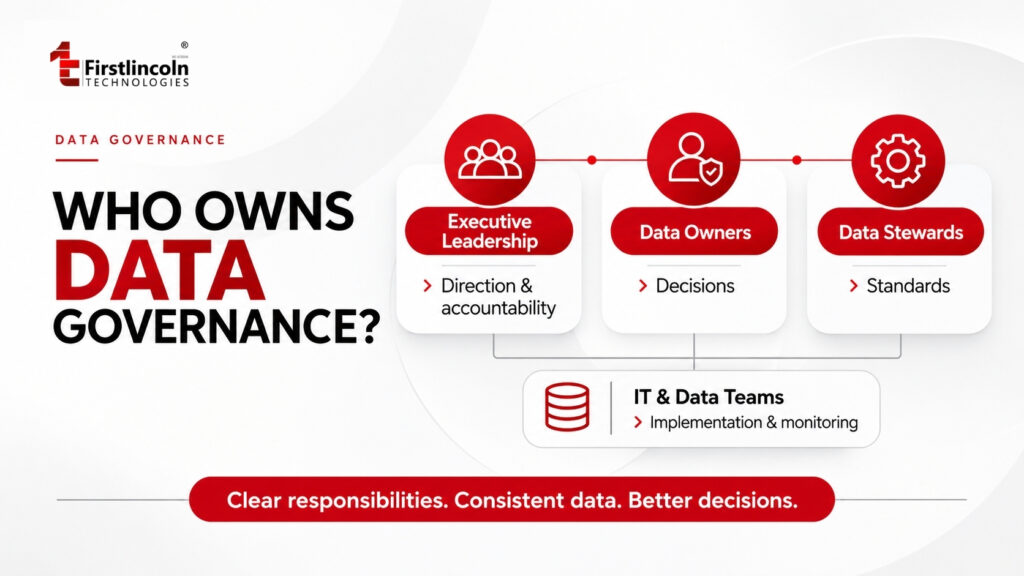
In most organizations, responsibility is distributed across business leadership, data owners, data stewards and technical teams. Each group has a different role in ensuring that business data is properly defined, managed and used.
Here is how these responsibilities typically work:
- Executive leadership: Provides direction, supports governance initiatives and ensures that data governance aligns with business objectives. In larger organizations, this may include a Chief Data Officer (CDO).
- Data governance council: Brings together representatives from different departments to establish policies, agree on standards and resolve disagreements about how organizational data should be defined and used.
- Data owners: Usually senior representatives of the business functions responsible for specific data domains, such as Finance owning financial data or Sales owning customer relationship processes. They are accountable for decisions about their data.
- Data stewards: Help maintain data definitions, document standards, monitor quality and ensure that agreed governance rules are followed.
- IT and data teams: Implement the technical processes that support governance, including data integration, access controls, storage, security and quality monitoring.
- Business users: Follow established standards when entering, accessing, updating and using organizational data.
The exact structure will vary depending on the organization’s size and complexity. A smaller business may assign several of these responsibilities to the same individuals, while a larger organization may have dedicated governance teams.
What matters is that every critical data domain has clear ownership and that there is an agreed process for making decisions when departments disagree.
What Does This Look Like in Practice?
Consider a company where the Sales and Finance departments produce different reports on the number of active customers.
Sales defines an active customer as anyone who has interacted with the business within the last six months. Finance, however, counts only customers who have completed a paid transaction within the same period.
Both departments are using customer information, but their definitions are different.
Rather than allowing both teams to continue producing competing figures, the company takes a governance-led approach:
- Identify the disagreement: The data governance council brings the issue to the attention of the relevant data owners from Sales and Finance.
- Review the business requirements: The teams establish why they need the metric and what decisions it is intended to support.
- Agree on a shared definition: They agree that an active customer, for the company’s main performance report, is a customer who has completed at least one paid transaction within the previous six months.
- Document the decision: The data steward records the agreed definition in the organization’s business glossary and communicates it to the relevant teams.
- Implement and monitor: The data team updates the reporting logic so that the agreed definition is consistently applied across the relevant dashboards.
Sales can still track customer engagement as a separate metric, while Finance can maintain its transaction-based reporting requirements. The important difference is that everyone now understands what the official active-customer metric represents.
This is how data governance turns conflicting interpretations into agreed business standards.
Why Growth Changes the Data Problem
When a business is small, informal knowledge can sometimes work. A few people may know which spreadsheet is current, how customers are defined, which revenue number Finance uses, where important information is stored, and who to ask when something looks wrong.
But growth changes the environment. New employees join, departments become more specialized, more software is introduced, and different teams begin collecting and using the same information for different purposes.
Reporting becomes more cross‑functional, analytics becomes more important, and eventually AI may be introduced into the organization’s workflows. The question then shifts from “Does someone know how this works?” to “Does the organization have an agreed way of working with this data?”
Research from McKinsey on data governance emphasizes that governance should scale according to an organization’s complexity and be connected to valuable business and analytics use cases. This is why governance should not be treated as something that only matters to large enterprises. The more people, systems, and decisions that depend on shared data, the harder it becomes to rely on informal agreements.
Sometimes the Problem Isn’t Bad Data. It’s Different Definitions.
Consider a simple business question: “What is our revenue?” It sounds straightforward, but the answer depends on which revenue is being measured — invoiced revenue, collected revenue, revenue for a particular period, revenue excluding refunds, or revenue recognized under a specific accounting rule.
Different teams may legitimately use different measures depending on what they are trying to answer. The problem begins when the organization assumes everyone is using the same definition when they are not.
The same challenge can arise with terms like customer, active customer, churned customer, completed order, qualified lead, inventory, employee, or profit.
This is why conflicting reports are not always a calculation problem; sometimes they are a governance problem. As Microsoft highlights in its governance guidance, common terminology and trusted sources help decision-makers work from consistent information.
The important distinction is that the organization may not be missing data — it may be missing agreement about the data.
That disagreement creates a hidden cost: employees spend time reconciling spreadsheets, analysts investigate why dashboards disagree, managers question reports instead of acting on them, and teams create their own unofficial versions of important metrics.
Eventually, people stop asking “What does the data tell us?” and start asking “Which number should we believe?”
Data Governance Is Not the Same as Data Management
These concepts are connected, but they are not interchangeable.
| Area | The practical question |
| Data governance | Who decides the rules, definitions and responsibilities? |
| Data management | How is data collected, stored, processed and maintained? |
| Data integration | How does information move between systems? |
| Data quality | Is the data accurate, complete, consistent and fit for purpose? |
Data management is the broader practice of working with data. Data integration helps connect different systems. Data quality focuses on whether information is reliable enough for its intended use.
Governance provides the accountability and decision-making layer that helps make these activities consistent.
That distinction matters because connecting systems does not automatically resolve disagreements about what the information means.
You can successfully integrate five systems and still have five different interpretations of “active customer.”
Integration Can Connect Data Without Creating Trust
This is particularly important for businesses investing in digital transformation. Suppose your CRM, accounting platform, and operations system are successfully connected — information can now move between them.
That is useful. But problems still arise if the systems use different customer identifiers, one system contains outdated records, teams define “active customer” differently, nobody knows which source should be authoritative, or there is no clear owner for correcting errors.
In these cases, the technology may be working exactly as designed, yet the business problem remains.
Integration connects information, while governance establishes the rules and accountability around that information. This is why data integration, data quality, and data governance should be viewed as complementary rather than interchangeable.
How Data Governance Supports Better Reporting and Analytics
Good reporting depends on more than having a dashboard. People need confidence in the information behind it.
A governed data environment can help establish shared definitions for important metrics, authoritative sources for key information, ownership of critical data domains, minimum quality expectations, appropriate access controls, and clear processes for changing important definitions.
That gives analysts and business users a shared foundation to work from.
Without it, reporting can become a continuous reconciliation exercise. An analyst may spend more time determining which dataset to use than analyzing what the data is actually saying.
And when different teams repeatedly produce different versions of the same metric, trust in analytics can decline — even when the organization has invested heavily in reporting technology.
Why AI Makes Data Governance Even More Important
AI does not remove the need for good data foundations. It increases it.
AI systems can process large amounts of information and generate outputs at a scale that would be difficult for people to handle manually.
But they still depend on the data, definitions and rules surrounding that information.
If customer data is inconsistent, an AI system does not magically make the underlying information consistent.
If important data has unclear ownership, AI does not solve the accountability problem.
If an organization cannot explain where critical information came from or whether it is appropriate for a particular use case, introducing AI can create additional questions around trust, access and responsible use.
Gartner’s research on data and analytics governance in the age of AI emphasizes the need for governance approaches to evolve as AI creates new requirements.
The OECD’s work on data access and sharing in the age of artificial intelligence also highlights the importance of quality data alongside appropriate safeguards for trustworthy data use.
Governance does not guarantee successful AI.
But as AI becomes more deeply integrated into business operations, organizations have even more reason to understand what data they have, where it comes from, who can use it and whether it is fit for the intended purpose.
How Can a Growing Business Start Data Governance Without Creating Bureaucracy?
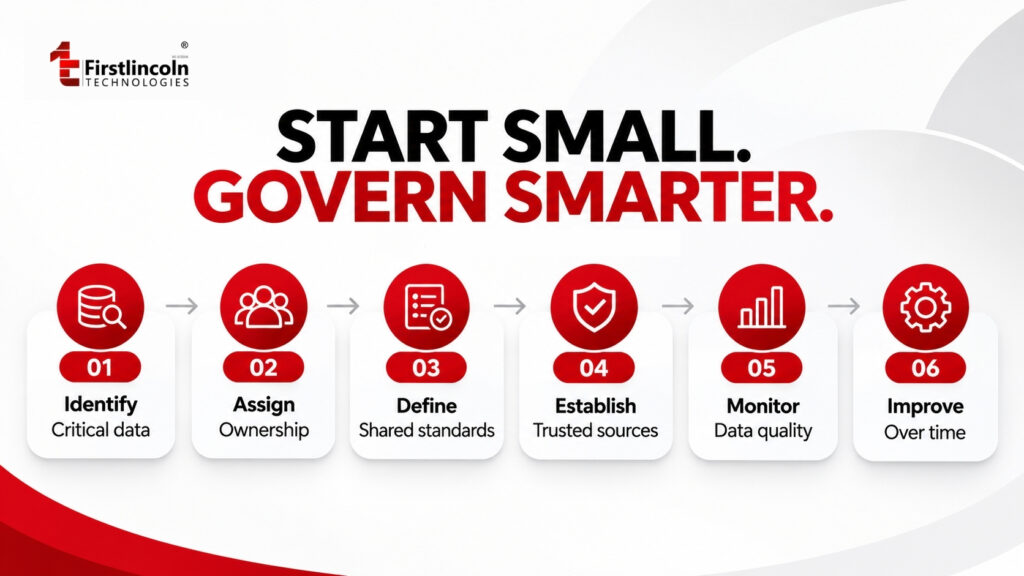
Data governance does not have to begin with a massive committee, hundreds of policies or a new department. A more practical approach is to start where the business is already experiencing friction.
1. Identify the data that matters most
Start with the data domains or business questions that have the greatest impact.
For example:
- customer information;
- sales;
- revenue;
- inventory;
- employee information;
- operational performance.
Do not try to govern everything at once.
2. Assign ownership
Determine who is accountable for important data domains. Ownership does not necessarily mean one person personally manages every record. It means there is clear accountability for the data and the decisions surrounding it.
3. Agree on important definitions
Create shared definitions for the metrics and business terms people regularly use. If “active customer” means something different to Sales and Finance, agree on what the organization means when it uses the term and document it.
4. Identify trusted sources
For important information, determine which system is authoritative for the business purpose. This helps reduce situations where multiple teams select different sources and arrive at different answers.
5. Establish minimum quality and access rules
Define the basic standards critical data should meet and establish who should have access to it. The level of control should reflect the sensitivity, importance and risk associated with the information.
6. Monitor and improve
Governance is not a one-time documentation exercise. Definitions change. Systems change. Business processes change. New data sources appear. Review the rules and ownership around critical data as the organization evolves.
7. Expand based on value
Once governance is working around one important domain or use case, apply what has been learned elsewhere.
This outcome-focused approach aligns with guidance from Microsoft, IBM and McKinsey: start with business value and scale governance according to the organization’s needs and complexity.
7 Signs Your Business May Have a Data Governance Problem
You may have a governance problem if:
- Different teams give different answers to the same business question.
- Nobody knows who owns an important dataset.
- Reports require significant manual reconciliation before meetings.
- Employees regularly ask which system contains the “real” information.
- Important definitions change without being documented or communicated.
- People have access to data without clear rules around how it should be used.
- AI or analytics projects repeatedly stall because the underlying data is inconsistent, unclear or poorly documented.
One of the clearest warning signs is this: Data exists in many places, but it is trusted nowhere.
The Real Value of Data Governance
Data governance is sometimes presented as a technical, compliance or administrative exercise.
For growing businesses, it is much more practical than that. It helps establish the rules that allow people across the organization to work from a shared understanding of the information they depend on.
Data integration helps connect the data. Data quality helps determine whether the data is fit for purpose. Data management helps organizations collect, store and use it.
Data governance helps establish who is responsible, what the data means, which rules apply and how decisions about that data are made.
And as a business grows, that distinction becomes increasingly important. Because growth does not just create more data. It creates more people making more decisions from that data.
The goal is therefore not to govern every piece of information with unnecessary bureaucracy. The goal is to reduce uncertainty around the data the business depends on.
When people know what the data means, where it comes from, who owns it and what standards apply, data becomes more than something the organization possesses. It becomes something the organization can confidently use.
Building a Stronger Data Foundation
For businesses looking to improve how they collect, integrate, manage and use their data, the first step is often not another tool. It is understanding where the current data foundation is creating friction.
At FirstLincoln, we help organizations build stronger technology and data foundations that support better reporting, analytics, automation and digital decision-making.
If your business has more data than confidence in its data, it may be time to examine the foundation underneath it.
Let’s help you build a more reliable data foundation. Contact FirstLincoln to discuss how we can support your organization’s data and technology needs.